
V-JEPA 2: From Watching Video to Planning Robot Actions
Published:
Mahmoud Assran, Adrien Bardes, David Fan et al.
Read the paper (PDF)
Observation and intervention carry different information
Intuition first. Watching a person move a cup reveals how the scene changes. To make a robot reproduce the change, the system also needs to relate its own commands to future observations. A visual feature extractor and an action-conditioned dynamics model solve different parts of that problem.
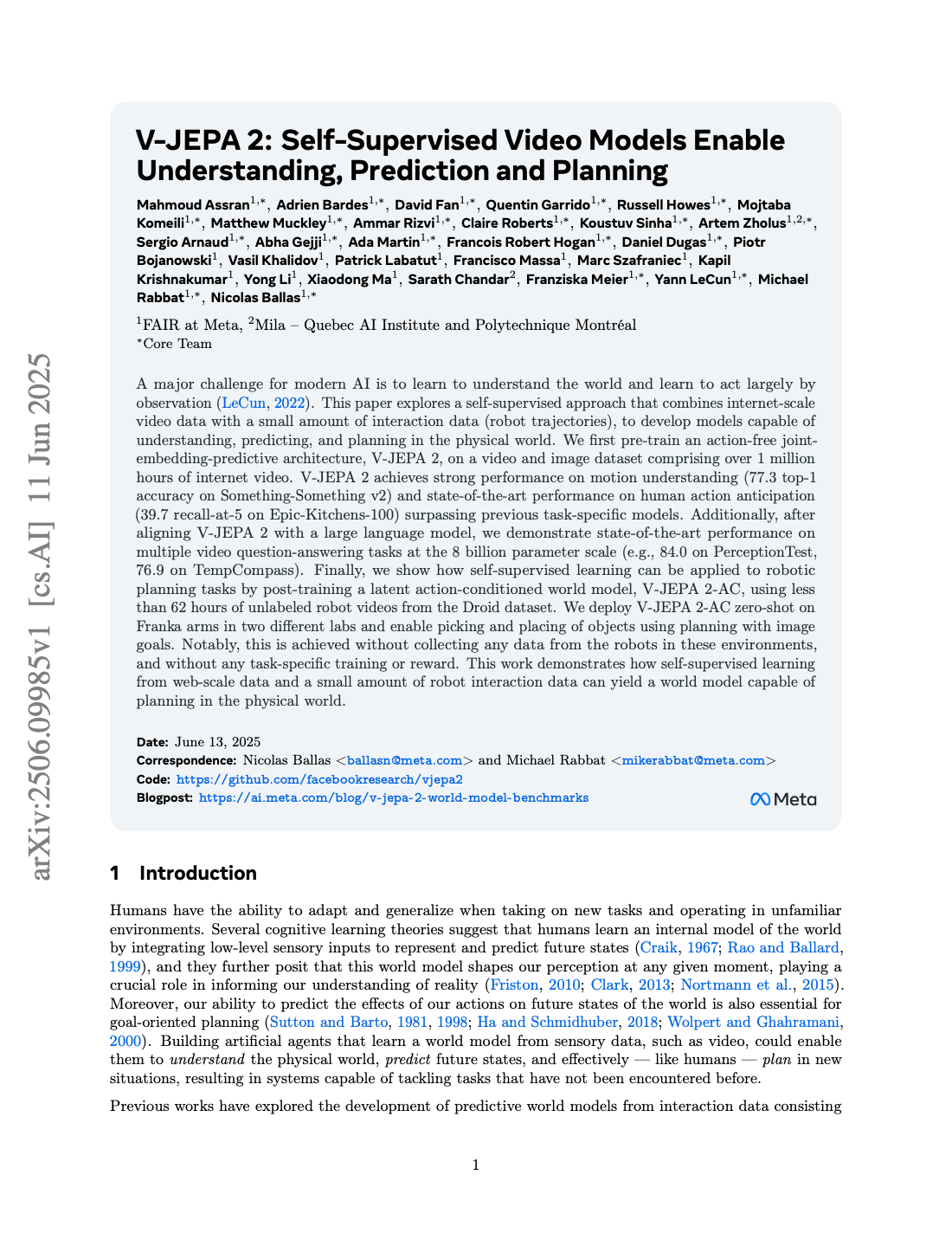
Assran et al. first train V-JEPA 2 on large-scale video and image data. They then train the action-conditioned V-JEPA 2-AC using fewer than 62 hours of robot interaction data from DROID. The paper reports image-goal planning on Franka arms in two labs without collecting training data in those deployment environments.
“Zero-shot” here describes that deployment setting. Robot interaction data still enters the earlier post-training stage.
From representations to candidate futures
To expose the planning idea, write a simplified latent rollout as
Here \(A\) is a proposed action sequence. This notation suppresses history, robot state, and patch structure to highlight the optimisation problem; it is not the complete model interface. The paper uses sampling-based planning with the cross-entropy method. Consult the planning details and official implementation for the actual conditioning and cost.
Worked example: a planner chooses between two sequences
For an illustrative two-dimensional goal \(z_g=(1,0)\), candidate A predicts a final state \((0.8,0.1)\) and candidate B predicts \((0.6,0)\). Using a squared Euclidean cost solely for this example,
The planner prefers A under this model and cost. That is a conditional decision: a prediction error could reverse the ranking. Suppose execution produces \((0.5,0.2)\) instead. The observed error is then \(0.29\), and another observation gives the controller a chance to revise its plan.
The numbers are latent coordinates, not metres. Their scale and meaning depend on the representation. A lower feature distance is useful only insofar as it tracks the task’s actual progress.
When the representation hides a control-critical detail
Imagine two states that look nearly identical: a cup is firmly grasped in one and merely touched in the other. If their embeddings are indistinguishable, a goal-distance planner may confidently lift in both. Improving the optimiser cannot recover information absent from its state representation.
Evaluate the complete loop with independent task success criteria. Include different initial positions, lighting, and contact conditions; record whether failures come from perception, prediction, candidate search, or execution. The paper’s robot demonstrations establish results in its tested settings, not unrestricted physical reliability.
For the control mechanics, read learned MPC. For a policy that directly predicts action chunks from demonstrations, compare ACT.
References
- Assran, M., et al. V-JEPA 2: Self-Supervised Video Models Enable Understanding, Prediction and Planning. 2025.
- Meta FAIR. Official V-JEPA 2 code and models.