
V-JEPA: Learning Motion by Predicting Video Features
Published:
Adrien Bardes, Quentin Garrido, Jean Ponce et al.
Read the paper (PDF)
Time changes what a feature must explain
Intuition first. A still frame of a hand beside a drawer does not tell you whether the drawer is being opened or closed. The surrounding frames can disambiguate the motion. A video representation should preserve this temporal information when it matters for the task.
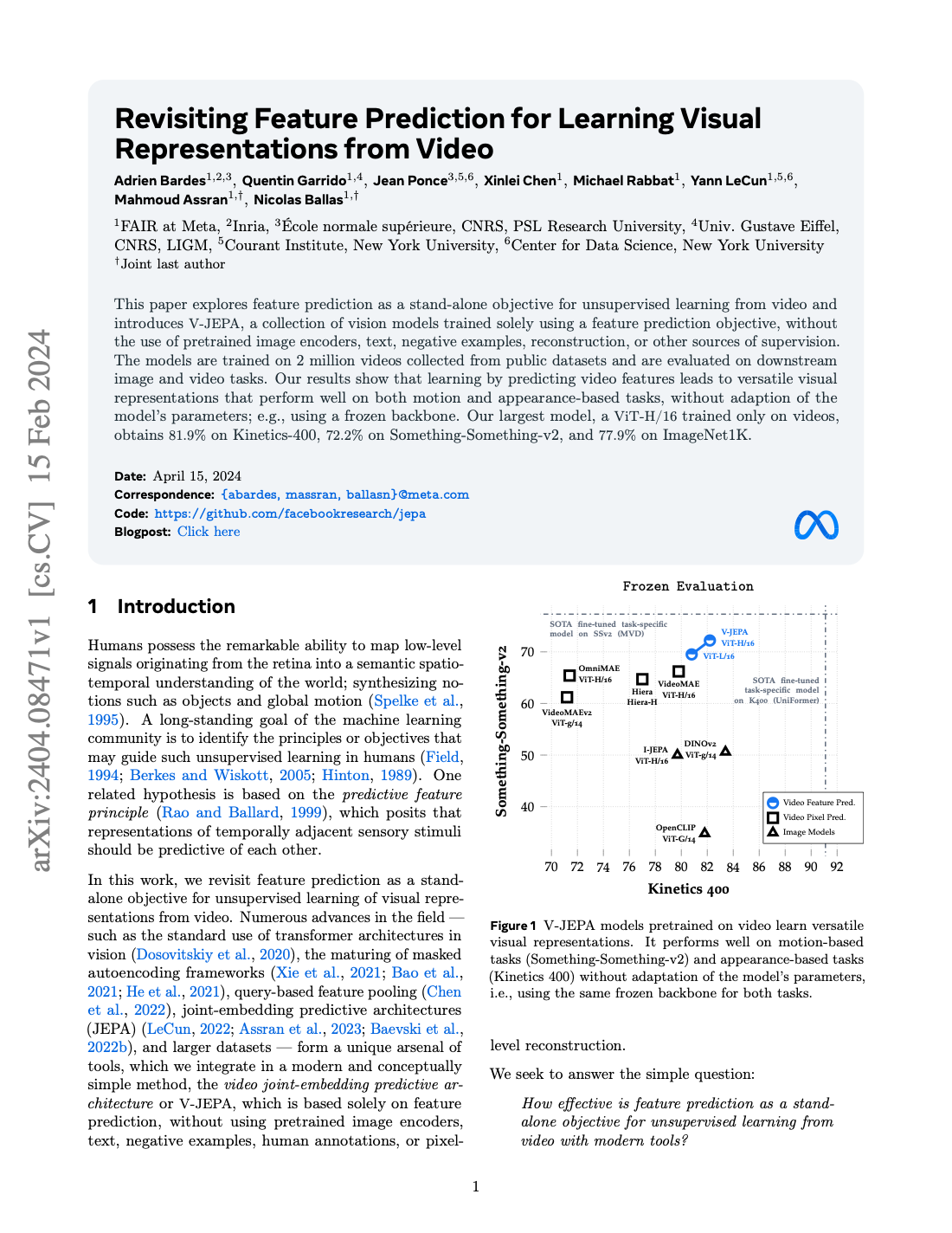
Bardes et al. train V-JEPA by hiding parts of a clip and predicting their representations. The context encoder processes visible video tokens; a moving-average target encoder supplies features from the complete clip. The predictor receives positional information identifying the missing tokens. The training objective uses feature prediction without pixel reconstruction or negative examples.
A loss indexed by space and time
Let \(M\) index masked video tokens, \(\hat z_i\) be a prediction, and \(z_i\) the target feature. The feature loss is
Each index now identifies a spatial location and temporal position. The paper describes the space-time masks, while the official code contains the tokenisation and training configurations.
Worked example: counting tokens, not frames
Consider an illustrative clip containing 16 frames at \(224\times224\) resolution. Suppose a token covers two frames and a \(16\times16\) spatial patch. The full clip contains
tokens. At an illustrative 75% mask rate, the context encoder processes 392 visible tokens, while 1176 positions are prediction targets. These numbers explain token accounting; they are not a claim about one particular released configuration.
This also separates encoder cost from whole-system cost. A smaller visible sequence reduces context-encoder attention work, but the target encoder and predictor still consume computation. Multiplying a mask percentage by total training cost would therefore give a misleading saving estimate.
Masked prediction and forecasting ask different questions
Suppose the model must predict the middle of a clip while seeing both its beginning and end. It can use evidence unavailable to a system operating online at the middle timestamp. A low error on that task does not measure past-only forecasting.
To evaluate online use, explicitly constrain the observation window, sample frames at the intended rate, and account for sensing and inference delay. For motion recognition, compare clips with similar objects but different temporal order. Otherwise, a model may succeed using scene appearance while missing the action distinction.
What a frozen evaluation measures
The original work evaluates learned features with a frozen backbone and trained downstream components on appearance and motion tasks. The backbone weights remain unchanged, but the task head still learns from labels. This distinction matters when comparing the results to zero-shot inference or full fine-tuning. Evaluation protocol.
Next, V-JEPA 2 adds the bridge from video representations to action-conditioned robot planning. I-JEPA explains the image version of the prediction problem.
References
- Bardes, A., et al. Revisiting Feature Prediction for Learning Visual Representations from Video. 2024.
- Meta FAIR. Official V-JEPA code and models.