
LeWorldModel: Learning Action-Conditioned Dynamics from Pixels
Published:
Lucas Maes, Quentin Le Lidec, Damien Scieur, Yann LeCun, and Randall Balestriero
Read the paper (PDF)
A world model must connect actions to consequences
Intuition first. A robot sees a block and considers pushing it left or right. A useful model must predict different consequences for those actions, while retaining the information needed to judge progress towards the goal.
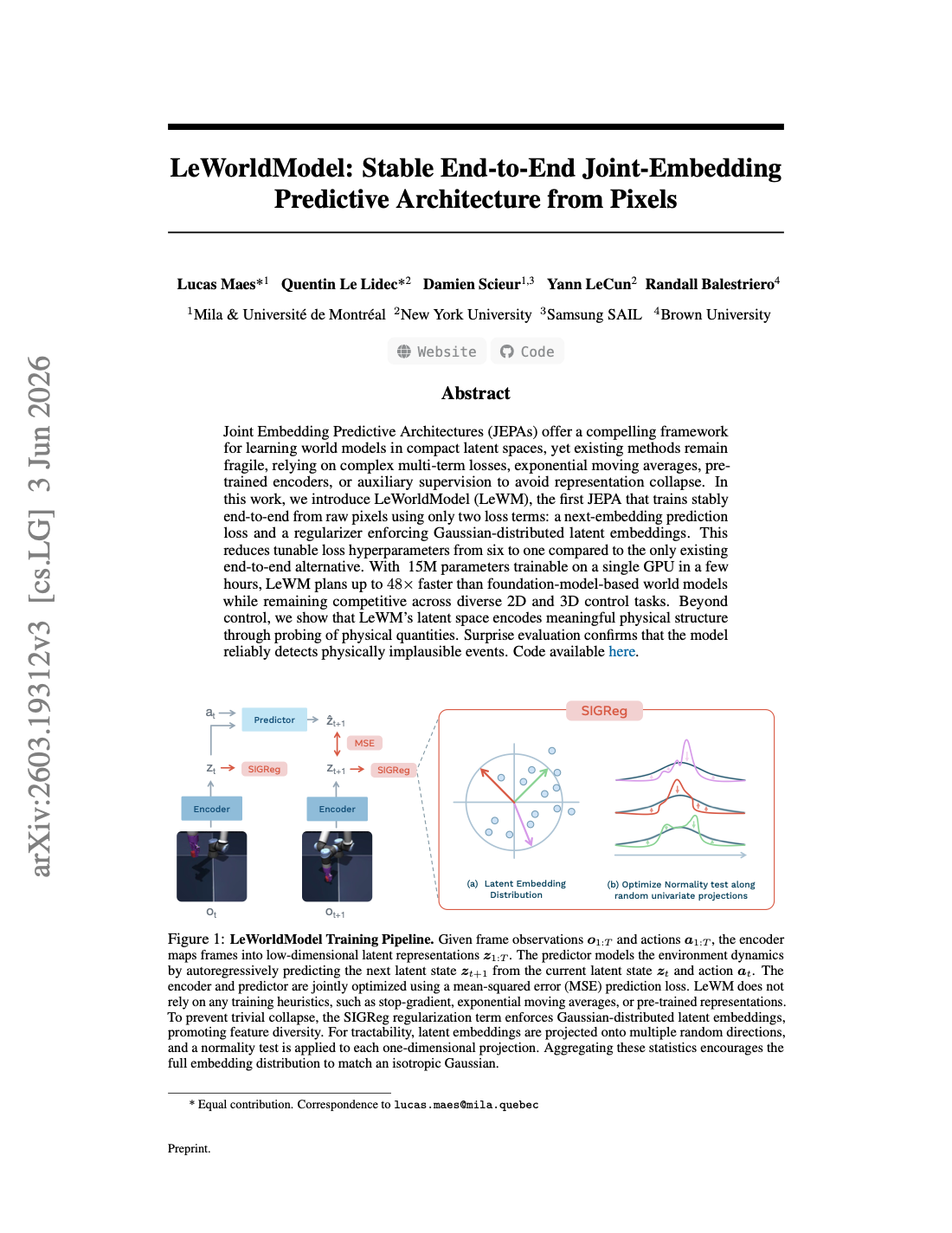
Maes et al. introduce LeWorldModel, or LeWM, which learns an encoder and predictor jointly from pixel observations and actions. It uses prediction plus Gaussian-distribution regularisation rather than a pretrained visual encoder, a pixel-reconstruction objective, or a moving-average target encoder. The method connects the representation geometry of LeJEPA to a sequential control problem.
Two loss terms, jointly differentiated
Let \(z_t=f_\theta(o_t)\) encode observation \(o_t\). Suppressing the predictor’s history window for readability, the objective is
\(Z\) collects training embeddings. SIGReg compares random projections with a Gaussian target. Gradients flow through both predicted and target representations; the complete predictor uses a causal history and action conditioning. Training formulation.
Prediction alone permits an uninformative constant representation. Regularisation constrains its distribution, while the action-conditioned prediction task supplies the relationship between successive observations.
Worked example: choosing an action sequence in latent space
Consider a deliberately simple scalar latent model \(\hat z_{t+1}=\hat z_t+a_t\). Start at \(z_0=0.4\) and set the goal to \(z_g=1.0\). Over three steps, candidate A applies \(0.2\) each time; candidate B applies \(0.1\) each time.
where \(J=(\hat z_3-z_g)^2\). The model prefers A. This arithmetic illustrates planning, not LeWM’s learned architecture or a physical unit conversion.
If the real latent transition adds an unmodelled 0.02 per step, A finishes at 1.06 instead. Its goal error becomes \(0.06^2=0.0036\). Even a small systematic one-step error can change a planned outcome over a longer horizon.
Teacher forcing and rollout are different conditions
During one-step training, the predictor receives representations of observed history. In a multi-step imagined rollout, its predictions become part of the context for later predictions. Errors can therefore move it away from the inputs used during training.
Evaluate rollouts at the horizons used by the controller, and test whether candidate trajectories are ranked correctly. Low average one-step error does not establish either property. The authors’ project page describes image-goal planning with the cross-entropy method.
Representation quality and task success need separate checks
A latent feature can encode position while ignoring whether an object is securely grasped. If that distinction matters for the task, a low goal distance can be misleading. Probe relevant physical quantities and evaluate full executions rather than treating a smooth latent trajectory as a success certificate.
The paper’s control and physical-prediction experiments support results within their protocols. Model size and planning speed comparisons also depend on the chosen baseline, hardware, and horizon.
Read learned MPC for the control loop, and compare V-JEPA 2 for a pipeline using large-scale visual pretraining before action-conditioned post-training.
References
- Maes, L., et al. LeWorldModel: Stable End-to-End Joint-Embedding Predictive Architecture from Pixels. 2026.
- Authors’ project page and implementation.