
LLM-JEPA: Add Representation Prediction Without Losing Text Generation
Published:
Hai Huang, Yann LeCun, and Randall Balestriero
Read the paper (PDF)
A description and a program can express the same requirement
Intuition first. “Select the names of customers with overdue invoices” and a corresponding SQL query are different strings that can describe the same operation. Their relationship supplies a training pair at a level above individual next-token choices.
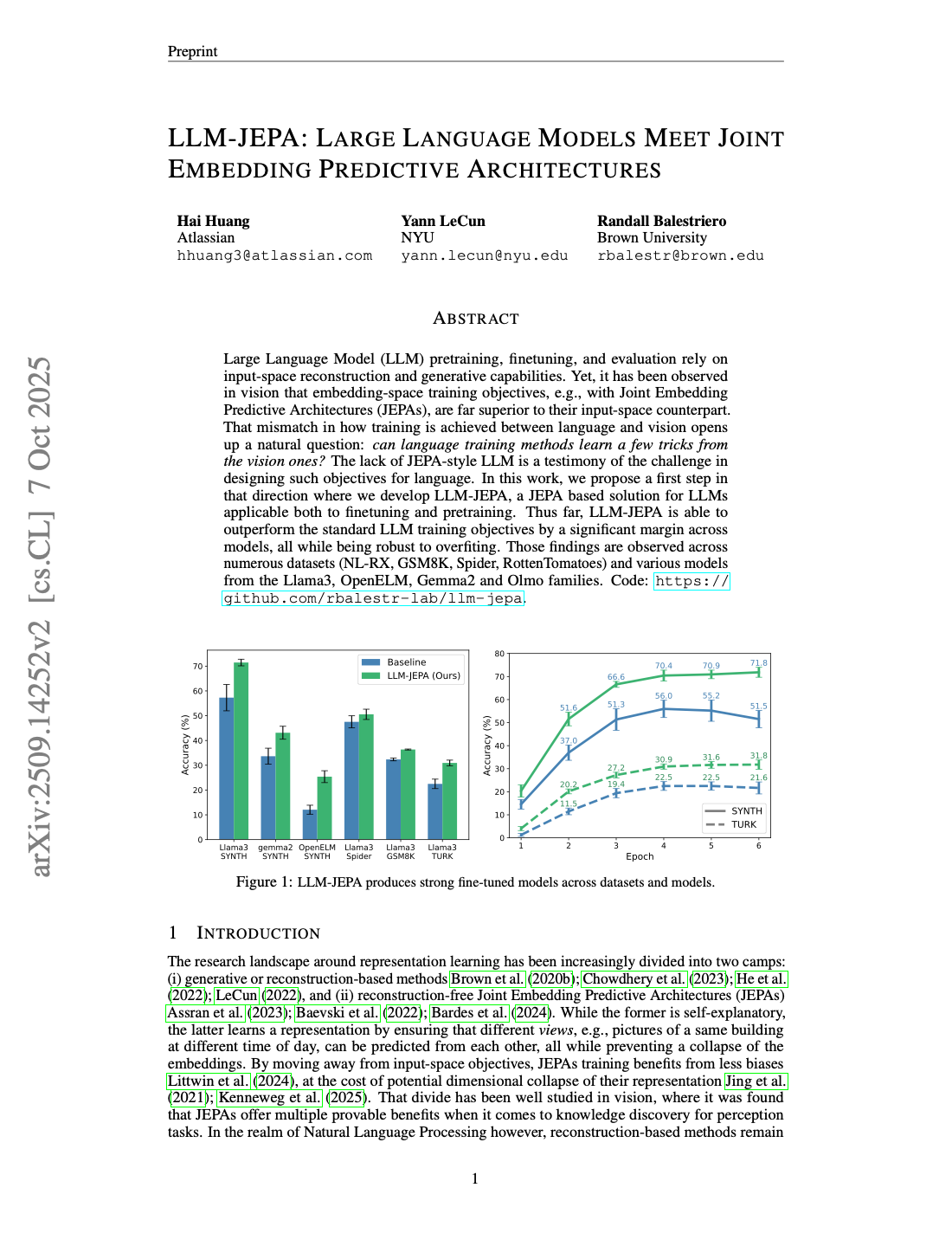
Huang, LeCun, and Balestriero use such related views to add JEPA training to language models. A prediction made from one view is matched to an embedding of the other, alongside the original language-model loss. Paired views are an important part of the setup; arbitrary neighbouring sentences are not guaranteed to express the same information.
Two objectives supervise different outputs
Write \(x\) for the source view and \(y\) for its paired target. A compact form of the objective is
The paper uses the last token’s final hidden state as a sequence representation. Appended prediction tokens let the same language-model weights perform the prediction computation. Related views are encoded separately, avoiding direct attention from the source view into its target. The method section and official code specify the construction and cosine-based comparison.
Worked example: interpret the loss components separately
For an illustrative cosine-distance convention, set \(d(u,v)=1-u^\top v\) for unit vectors. Let the predicted embedding be \((1,0)\) and its target \((0.8,0.6)\). Both have unit norm, so their distance is \(1-0.8=0.2\).
With language loss 1.4 and an illustrative weight \(\lambda=0.3\),
If the embeddings align perfectly, the extra term becomes zero, but the language loss may still be large. Conversely, a model can improve token predictions without satisfying the cross-view relation. Plotting the components separately reveals which task is improving.
Loss scale matters: changing a token loss from a sum to a mean changes its balance with the embedding term. The numerical value of \(\lambda\) is meaningful only together with the reduction and normalisation conventions.
Training-time information is not inference-time input
The paired answer supplies supervision during training. At inference, a user normally supplies only the source prompt and the model generates its answer. A useful evaluation must respect that boundary.
For a text-to-SQL example, providing the correct SQL to the embedding branch during evaluation would test a different system from one that must generate it. Separate representation diagnostics, which may use paired data, from the actual generation task.
The added encoding passes also cost training computation. The paper’s design does not require those paired-view passes for ordinary generation, but that does not imply cost-free training or the elimination of autoregressive decoding.
What evidence would establish a useful representation?
A close embedding pair does not guarantee an executable or correct program. Two SQL statements may have similar wording and different filters. Evaluate the generated operation on appropriate tests or benchmark protocols, and inspect whether the representation preserves those critical differences.
Compare VL-JEPA, which predicts an answer embedding from visual input, and LeJEPA for explicit distribution regularisation.
References
- Huang, H., LeCun, Y., & Balestriero, R. LLM-JEPA: Large Language Models Meet Joint Embedding Predictive Architectures. 2025.
- Authors’ LLM-JEPA implementation.