
p-RoPE: What Makes Rotary Positional Encodings Useful?
Published:
Worked Example: Frequency Roles in a Trained Model
Consider a trained LLM (e.g., Gemma 7B) with head dimension d = 256, so d/2 = 128 frequency pairs.
High-frequency dimensions (i near 0, short wavelength):
- θ₀ = 1 (highest frequency, one full rotation per token)
- The attention pattern using this dimension can distinguish position 5 from position 6 precisely
- Observed in Gemma 7B: heads that perform positional lookup (e.g., attending to the previous token, or tokens exactly 3 positions back) rely heavily on these high-frequency dimensions
Low-frequency dimensions (i near 64, long wavelength):
- θ₆₄ = 1/10000^(64/128) = 1/100 (one rotation per 628 tokens)
- These complete less than one cycle within a typical 2k context, the angle barely changes
- The paper finds: the model repurposes these near-constant dimensions as stable semantic features (the rotation is so slow it behaves almost like no rotation at all)
p-RoPE intervention:
- Standard RoPE rotates all 128 pairs
- p-RoPE: drop rotation on the lowest p% of frequency pairs (e.g., the 32 lowest-frequency pairs, i = 97…128)
- Those 32 pairs now act as pure semantic channels, no positional interference
- The remaining 96 pairs still carry all the positional signal needed
What the Paper Tries to Explain
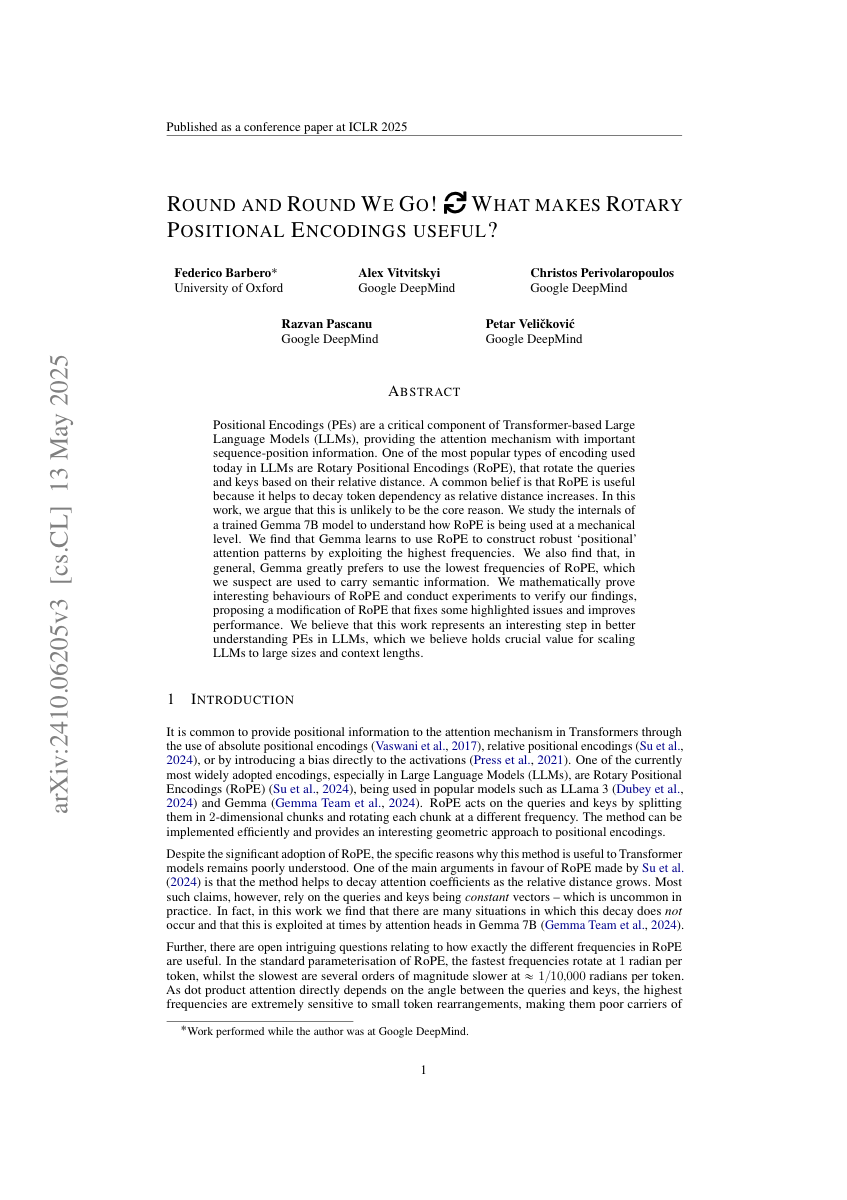
RoPE had become the default positional encoding for modern LLMs, but the explanation people repeated was often vague: it supposedly helps by making attention weaken with relative distance.
The authors argue that this is not the full story. They inspect a trained Gemma 7B model and study how RoPE is actually used internally. Their main conclusion is much more interesting:
- the highest frequencies are used to build precise, robust positional attention patterns
- the lowest frequencies are strongly preferred by the model and seem to function more like semantic carriers
That immediately suggests a design question: if low frequencies are often being repurposed semantically, should all frequencies really be rotated?
The p-RoPE Idea
The answer proposed by the paper is partial RoPE, or p-RoPE. Instead of applying rotary embeddings to the full frequency range, you truncate the lowest-frequency part and keep only the more useful positional bands.
In simplified form:
The point is not to make RoPE weaker. It is to make the roles cleaner:
- high frequencies stay available for positional circuitry
- the lowest-frequency channels are no longer forced through unnecessary rotations
Why This Makes Sense
If the model already wants to use low frequencies as stable semantic features, rotating them may be counterproductive. By not rotating that part of the space, p-RoPE gives the model a cleaner semantic pathway while preserving the sharper positional machinery where it matters most.
This is why the proposal is interesting even beyond its benchmark gains. It suggests that positional encodings should perhaps be treated less as monolithic blocks and more as frequency-partitioned tools.
What It Adds to the Positional-Encoding Story
This paper is especially valuable because it sits between theory and engineering:
- it gives a mechanistic explanation of RoPE behaviour
- it derives a practical positional variant from that explanation
So in the broader book sequence, p-RoPE belongs right after RoPE itself and before the long-context extension methods. It is the chapter that asks:
before we extend RoPE, do we even understand which parts of RoPE are doing what?
That makes it one of the most useful “bridge” papers in the series.
Practical Takeaway
You should not think of p-RoPE as “the new default positional encoding.” The more important takeaway is the frequency decomposition insight:
- some frequencies are much more useful for explicit positional attention patterns
- some are better left to semantic representation
That perspective helps make sense of why later methods like FoPE, NTK scaling, YaRN, and LongRoPE all end up reasoning so heavily about frequency bands.
✅ Key Takeaways
- This paper argues that RoPE's value is not mainly simple distance decay.
- High frequencies help build sharp positional attention patterns.
- Low frequencies are often reused as more stable semantic channels.
- p-RoPE drops the lowest rotary frequencies to preserve those semantic channels and can improve performance.
References
- [1] Barbero, F., Vitvitskyi, A., Perivolaropoulos, C., Pascanu, R., Veličković, P. (2024). Round and Round We Go! What makes Rotary Positional Encodings useful?. ICLR 2025.
- [2] Su, J., Lu, Y., Pan, S., Murtadha, A., Wen, B., Liu, Y. (2021). RoFormer: Enhanced Transformer with Rotary Position Embedding. arXiv 2021.