
FoPE: Fourier Position Embedding for Length Generalization
Published:
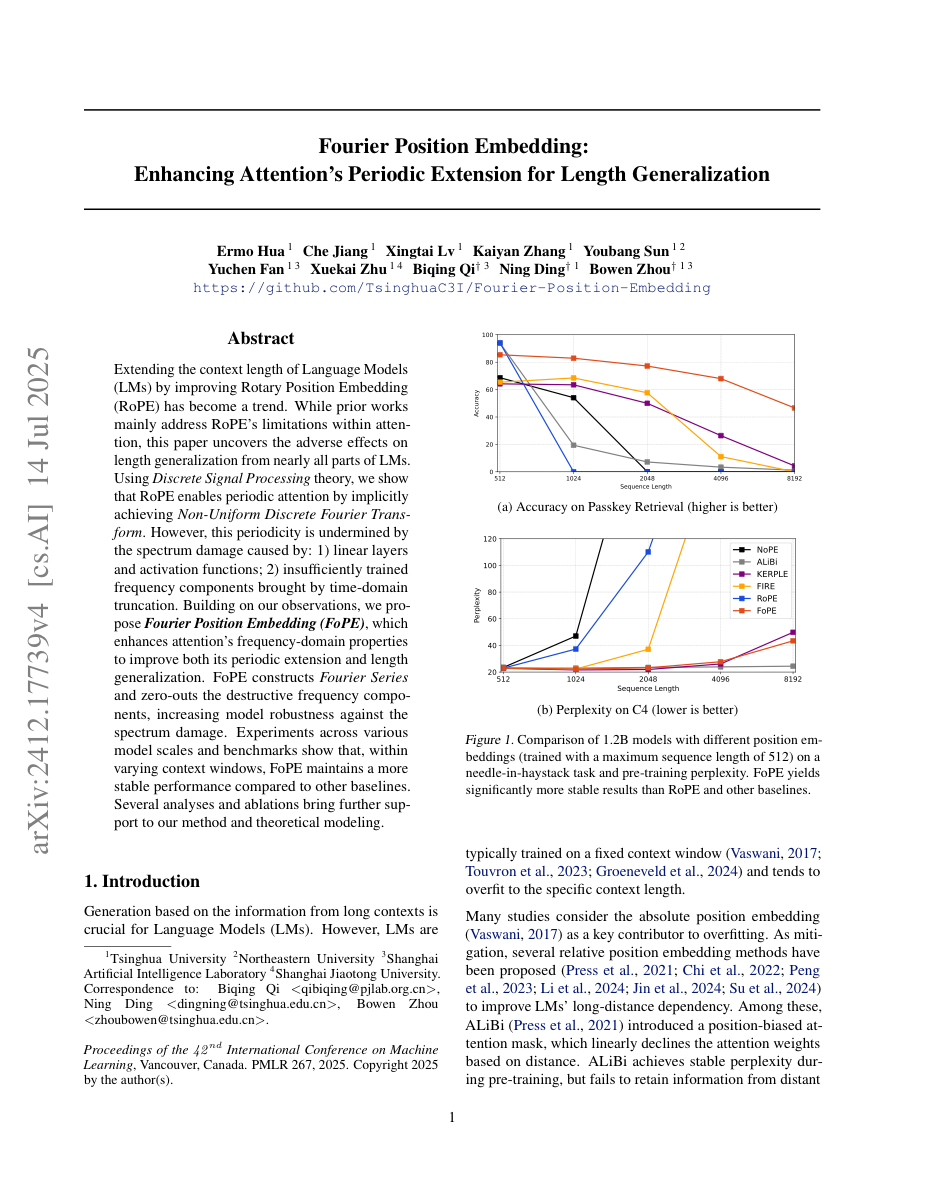
Intuition First: The Periodic Extension Problem
Every positional encoding scheme must answer: “what happens when the model is asked about position 8000 but was only trained up to position 4096?”
Most answers are: “stretch or rescale the coordinates so 8000 looks like something familiar.” That is the PI / NTK / YaRN family of answers.
FoPE asks a more fundamental question: “what is the natural mathematical continuation of the positional signal beyond the training window, and how can we design the encoding so that continuation is well-behaved?”
Think of it this way: a sine wave of frequency f, when you extend its domain, simply continues the same oscillation, that is a clean periodic extension. If your positional encoding is a superposition of sinusoids, the behaviour at longer contexts is entirely determined by how those sinusoids continue. FoPE explicitly controls that continuation in the frequency domain, rather than just rescaling inputs and hoping for the best.
Why This Paper Matters
Most of the long-context positional-encoding story has focused on practical recipes:
- interpolate positions
- rescale RoPE frequencies
- blend low- and high-frequency dimensions differently
Those methods work, but they are often introduced as engineering tricks. FoPE is interesting because it tries to explain the same problem more fundamentally. The paper argues that length generalization should be understood through the frequency-domain behaviour of attention, especially through how positional structure extends periodically beyond the training range.
The Core Idea
The name gives away the perspective: Fourier Position Embedding. The method is built around the observation that attention and positional encoding have a natural periodic structure, and that this structure matters once context length grows past what the model saw in training.
In simplified terms, FoPE says:
That is not the exact implementation formula, but it is the right mental model. The paper is less about “one more RoPE scaling constant” and more about controlling how the positional signal continues when the model is pushed to unseen lengths.
How It Differs from RoPE Extensions
RoPE and its descendants already use sinusoidal or rotational structure, so they are naturally tied to Fourier ideas. But most RoPE extension methods still act locally:
- rescale positions
- rescale frequencies
- reweight frequency bands
FoPE is more global in spirit. It asks whether the periodic continuation itself is well shaped for attention. That is why it belongs in the same family as long-context RoPE methods, but still feels conceptually different from NTK scaling or YaRN.
When This Is Useful
FoPE is useful if you want to understand not only how to extend context, but why some positional schemes generalize better than others. It is especially valuable as a conceptual bridge between:
- classical Fourier-style positional encodings
- rotary embeddings and their long-context fixes
- newer attempts to reason about extrapolation through signal-processing or kernel views
So even if you deploy YaRN or LongRoPE in practice, FoPE is the kind of paper that sharpens the mental model behind the whole field.
Where It Fits in the Series
If you read the positional-encoding chapters as a progression, FoPE belongs late in the story:
- Sinusoidal / learned / relative explain the early positional ideas
- RoPE turns position into rotation
- PI / NTK / YaRN / LongRoPE show practical long-context fixes
- FoPE steps back and asks what the periodic extension should look like in the first place
That is why it is useful: it is not just another trick, but a more explanatory lens on long-context behaviour.
✅ Key Takeaways
- FoPE treats length generalization as a frequency-domain and periodic-extension problem.
- It is conceptually close to RoPE extensions, but more explanatory than purely heuristic.
- The method is useful for understanding why some long-context positional encodings extrapolate better.
- In the positional-encoding story, FoPE belongs after the practical long-context RoPE fixes.
References
- [1] Hua, E., Jiang, C., Lv, X., Zhang, K., Sun, Y., Fan, Y., Zhu, X., Qi, B., Ding, N., Zhou, B. (2024). Fourier Position Embedding: Enhancing Attention’s Periodic Extension for Length Generalization. arXiv 2024.
- [2] GitHub repository: TsinghuaC3I/Fourier-Position-Embedding.