
HetSheaf: Heterogeneous Graphs Meet Cellular Sheaves
Published:
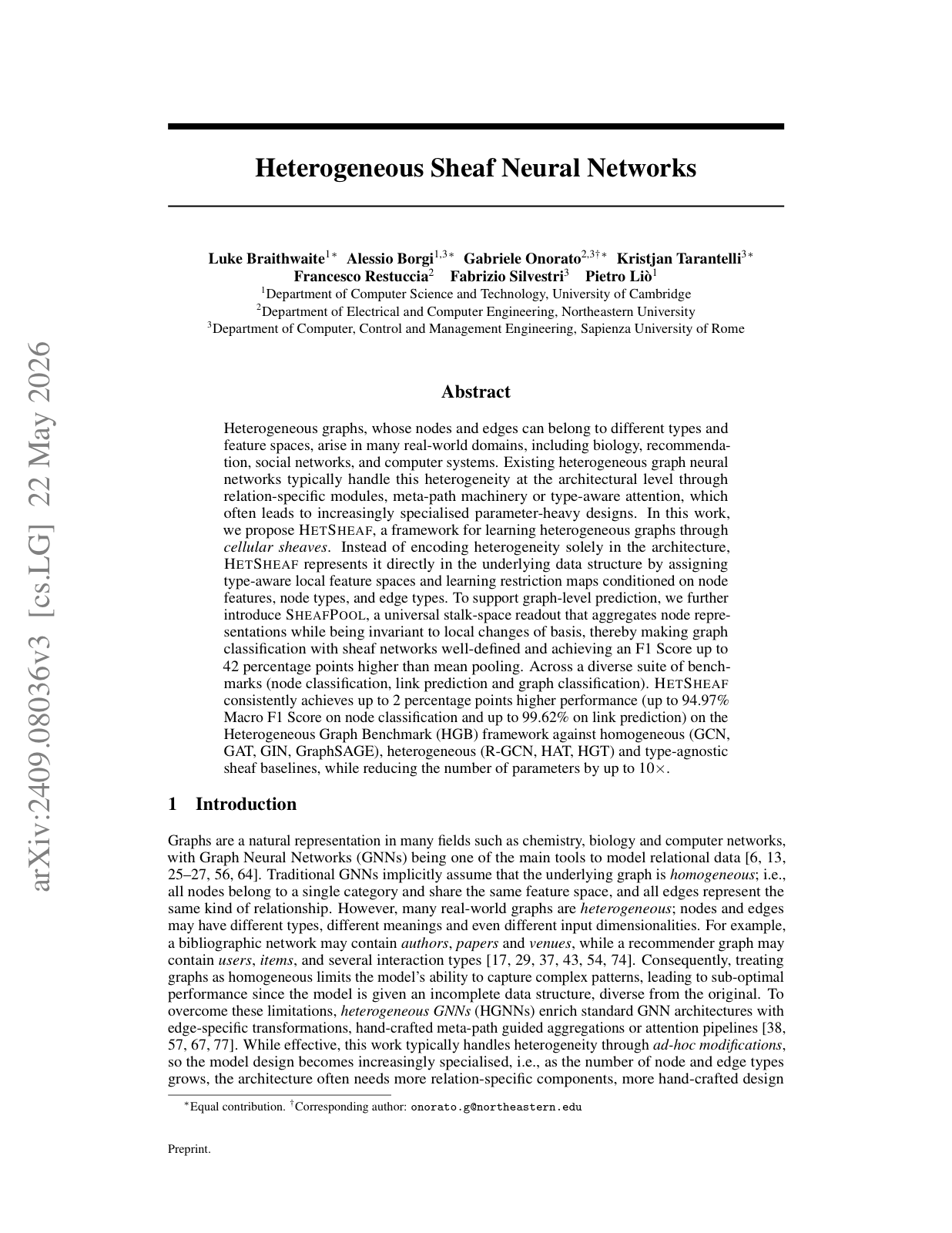
The Problem: Heterogeneity is Expensive
Real-world graphs are rarely uniform. In a knowledge graph, nodes can be people, organisations, or concepts; edges can be authored, affiliated with, or cited. This is heterogeneity: multiple node types and edge types, each with its own feature space.
Existing heterogeneous GNNs, R-GCN, HAN, HGT, handle this by adding type-specific modules: one transformation matrix per relation type, one attention head per meta-path, or separate encoders per node type. The result is parameter bloat and architectural complexity that grows with the number of types.
HetSheaf asks: can we encode heterogeneity in the structure rather than the architecture?
The Intuition in One Sentence
HetSheaf treats node type and edge type not as a reason to build a different neural layer for every relation, but as a reason to build a richer local geometry: typed stalk semantics, type-conditioned restriction maps, same global propagation rule.
The Core Idea: Type-Aware Sheaves
A cellular sheaf assigns a vector space (a stalk) to each node and edge, plus a restriction map for each endpoint of each edge that says “how does the signal on this node relate to the signal on this edge?” In standard Sheaf Neural Networks, all stalks are the same size and restriction maps are unconstrained.
HetSheaf makes two changes:
Type-aware stalks: Each node and edge keeps the same stalk dimension, but the stalk content is made type-aware through the learned sheaf construction. In other words, HetSheaf does not yet assign different stalk sizes to different types; instead, it uses a shared-dimensional local space whose semantics depend on node and edge type. Allowing genuinely different stalk dimensions across types is a natural future direction, but it is not part of the current method.
Conditioned restriction maps: The restriction map for each edge endpoint is conditioned on the node features, node type, and edge type. This lets the model learn type-specific relational structure automatically, without separate architectural components per relation.
Mini-Example: 3-Node Heterogeneous Graph
Consider a small graph with nodes A (person), B (org), C (concept), two edges \(e_{AB}\) and \(e_{BC}\).
Standard SNN (type-blind): both edges use the same learned matrix \(W \in \mathbb{R}^{2 \times 2}\).
HetSheaf (type-conditioned): each edge type gets its own restriction map, conditioned on the node’s type embedding \(\tau\) and features \(h_v\).
The disagreement at \(e_{AB}\) that the Sheaf Laplacian penalises is then:
With type-conditioned maps, this disagreement is measured in the coordinate frame appropriate to the A–B relation, not in a generic frame shared by all edge types. A person-to-org relationship and an org-to-concept relationship are penalised on their own terms.
Sheaf Predictors
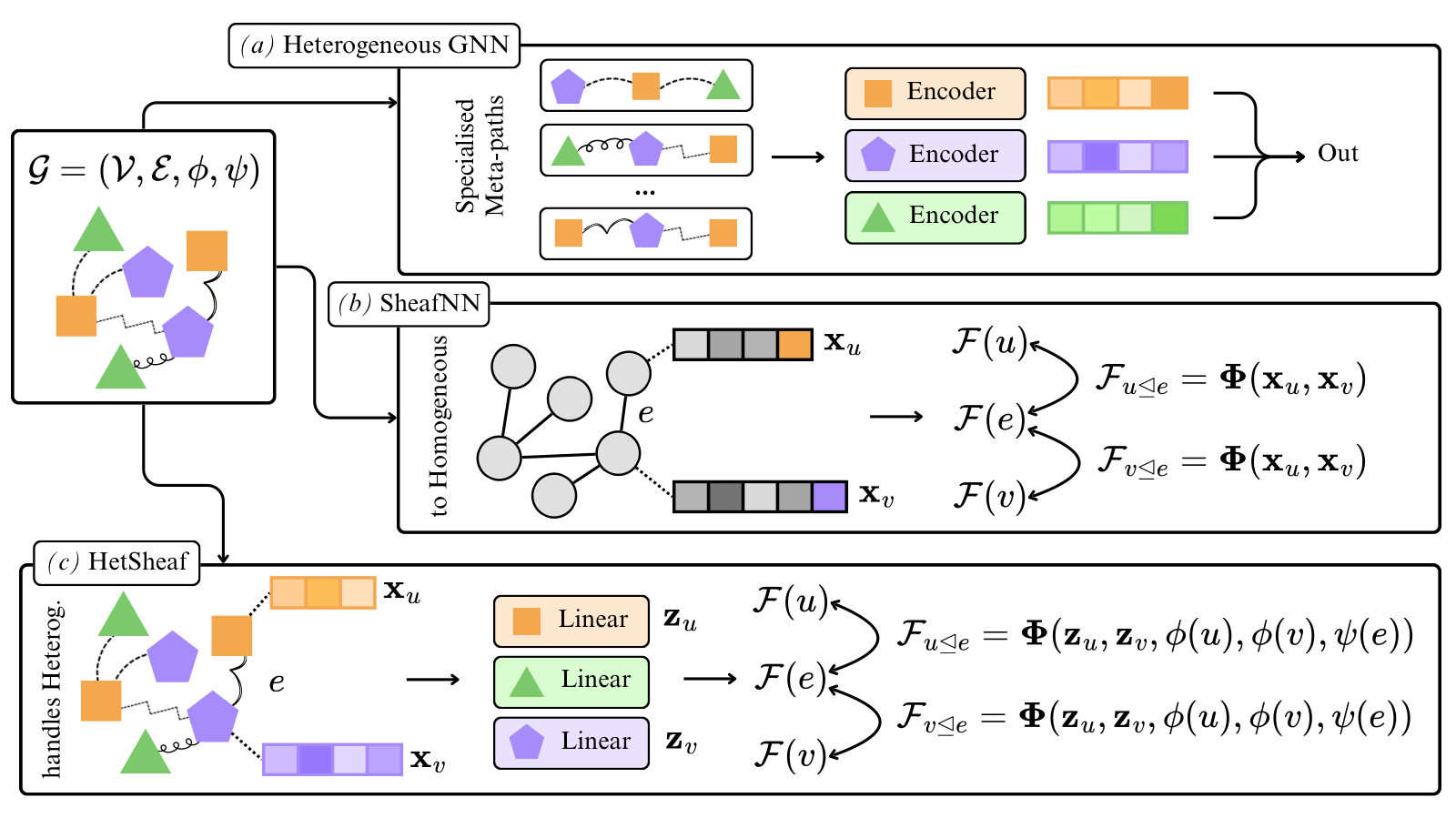
The restriction maps can be instantiated in different ways, giving a family of Heterogeneous Sheaf Predictors (HSPs). The paper explores several variants ranging from linear maps to nonlinear maps conditioned on concatenated node/edge features.
SheafPool: Graph-Level Readout
The graph-classification problem is simple to state:
- ordinary GNNs can sum or average node embeddings directly;
- sheaf GNNs cannot, because each node lives in its own local coordinate frame.
So naive pooling is not just weak, but wrong. Two stalk vectors can represent the same geometric content in different bases, and direct averaging would treat them as different. The final graph embedding would then depend on arbitrary local frame choices instead of only on the graph.
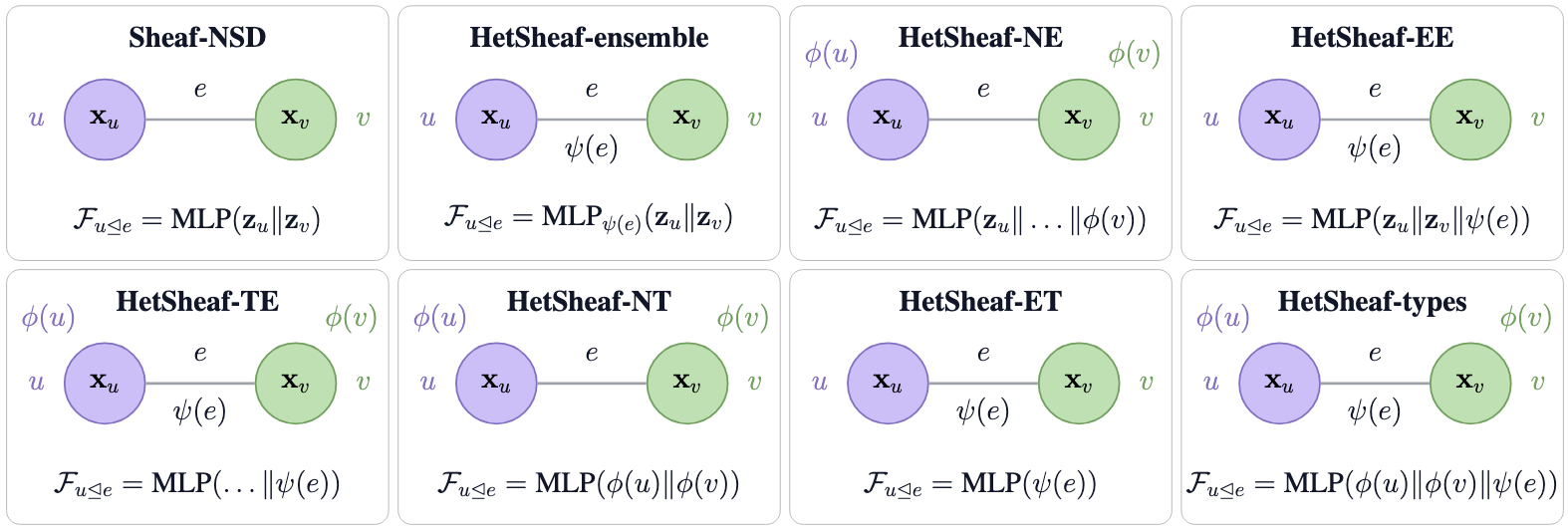
SheafPool fixes this by making the readout basis-invariant.
In practice, it does four things:
- Normalise each stalk locally.
- Align stalks to a shared anchor frame.
- Score nodes with invariant attention weights.
- Pool the aligned stalks into one graph representation.
The key idea is: align first, pool later. That is what makes graph-level prediction well-defined in sheaf space, especially on heterogeneous graphs where local geometry is already more complex.
Results
Evaluation uses the Heterogeneous Graph Benchmark (HGB): node classification on ACM, DBLP and IMDB, and link prediction on LastFM and MovieLens. Baselines are GAT, GCN, HAN, R-GCN and HGT, plus HetSheaf-NSD, the same pipeline with an ordinary type-blind sheaf predictor, which is the ablation that isolates what the type conditioning actually contributes.
Node classification (Macro F1 / Micro F1, 10 runs):
| Model | ACM | DBLP | IMDB |
|---|---|---|---|
| HetSheaf | 96.39 / 96.35 | 97.93 / 98.08 | 87.12 / 87.88 |
| HetSheaf-NSD | 94.97 / 94.94 | 96.69 / 96.89 | 86.70 / 87.50 |
| R-GCN | 95.81 / 95.75 | 96.79 / 97.01 | 88.16 / 89.08 |
| HGT | 93.24 / 93.30 | 93.91 / 94.26 | 87.74 / 88.45 |
| GCN | 89.09 / 89.14 | 96.31 / 96.57 | 82.41 / 83.99 |
Link prediction (AUPR / AUROC, 10 runs):
| Model | LastFM | MovieLens |
|---|---|---|
| HetSheaf | 98.24 / 97.80 | 99.68 / 99.59 |
| HetSheaf-NSD | 97.16 / 96.58 | 99.66 / 99.57 |
| R-GCN | 96.86 / 96.97 | 99.06 / 99.13 |
| GCN | 96.84 / 96.42 | 99.57 / 99.51 |
| HGT | OOM | OOM |
Reading these carefully:
- State of the art on ACM and DBLP, and by a smaller margin than headline summaries of this work tend to suggest: +0.58 Macro F1 over R-GCN on ACM and +1.14 on DBLP.
- On IMDB, R-GCN wins, 88.16 against 87.12 Macro F1, and HGT also edges ahead. HetSheaf is competitive there, not best, and it reaches that with a far smaller parameter budget.
- Link prediction is a clean sweep on both datasets and both metrics. The +1.22 AUROC over HetSheaf-NSD on LastFM is the single clearest demonstration that the type conditioning, and not merely the sheaf, is doing work. HGT runs out of GPU memory on both.
- Parameter efficiency is the strongest claim. Averaged across datasets, the largest sheaf variant is roughly 111× smaller than R-GCN and 17× smaller than HGT. On ACM concretely: 155K parameters against R-GCN’s 43M and HGT’s 7.2M.
Why This Matters
The important shift is conceptual. Most heterogeneous GNNs ask: “what new neural block do I need for this new graph type?” HetSheaf asks: “what local compatibility structure does this graph already have?” Once that structure is encoded in the sheaf, the downstream model becomes simpler, more principled, and easier to scale as the number of types grows.
✅ Key Takeaways
- HetSheaf moves heterogeneity from the architecture into the data structure via type-aware sheaves.
- Restriction maps conditioned on node/edge types encode relational structure without type-specific modules.
- SheafPool provides a basis-change-invariant graph-level readout, essential for correct graph classification with sheaves.
- State of the art on ACM and DBLP node classification and on both link-prediction benchmarks; R-GCN still wins IMDB.
- Roughly 111× fewer parameters than R-GCN and 17× fewer than HGT, because the sheaf predictor computes relation-specific maps instead of storing per-relation weights.
- General restriction maps beat orthogonal ones here, the reverse of the homogeneous case, and a sign that the best map family depends on the task.