
LongRoPE: Extending Context to 2 Million Tokens
Published:
Pushing Beyond YaRN
YaRN divides RoPE dimensions into three zones (high-freq, mid-freq, low-freq) with a hand-designed blending function. This works well up to ~128k tokens. But at extreme lengths, 512k, 1M, 2M, the approximation breaks down.
LongRoPE (Ding et al., Microsoft Research, 2024) takes a fundamentally different approach: instead of designing the rescaling analytically, search for the optimal per-dimension rescaling factors directly.
The Core Idea: Per-Dimension Search
In standard RoPE, each dimension pair \(i\) uses frequency \(\theta_i\). To extend context, all methods modify these frequencies. LongRoPE generalises: each dimension \(i\) gets its own learned rescaling factor \(\lambda_i\):
Setting all \(\lambda_i = s\) (the scale factor) gives linear interpolation. Setting \(\lambda_i\) via the NTK formula gives NTK scaling. YaRN approximates the optimal \(\lambda_i\) with a three-zone formula.
LongRoPE instead searches for the optimal vector \(\lambda = [\lambda_0, \lambda_1, \dots, \lambda_{d/2-1}]\) directly using an evolutionary search algorithm (specifically, a variant of CMA-ES, Covariance Matrix Adaptation Evolution Strategy).
The Evolutionary Search
Objective function: on a set of long-context validation documents, evaluate perplexity for a given \(\lambda\) vector.
Search procedure:
- Initialise \(\lambda\) using YaRN’s formula as a warm start
- Run evolutionary search (population of candidate \(\lambda\) vectors)
- For each candidate: compute attention scores with modified RoPE, measure perplexity
- Select best candidates, apply mutations, repeat
- Return \(\lambda\) that achieves minimum perplexity on long sequences
The search is done with the frozen original model weights, no gradient updates. Only \(\lambda\) is optimised (it is not a learned parameter in the usual sense; it is found by black-box search).
The Big Picture
LongRoPE shows that long-context extension is not just about “stretching positions.” At extreme lengths, different rotary dimensions need different treatment, and brute-force search can outperform hand-designed formulas.
The Two-Stage Training Pipeline
After finding \(\lambda\) via search, LongRoPE uses two short fine-tuning stages:
Stage 1: Extreme extension (e.g., 2M tokens)
- Apply the searched \(\lambda\)
- Fine-tune for ~400 steps on long documents (8k–128k sequence length)
- This adapts the model weights to the new rotary frequencies at maximum context
Stage 2: Short-context recovery
- The model after Stage 1 performs slightly worse at short contexts
- Fine-tune with a smaller \(\lambda\) (less aggressive rescaling) for ~200 steps
- This recovers near-original performance at the original training length
The two-stage approach is crucial: Stage 1 enables long context, Stage 2 prevents short-context regression, a problem that YaRN and NTK methods also face but do not explicitly address.
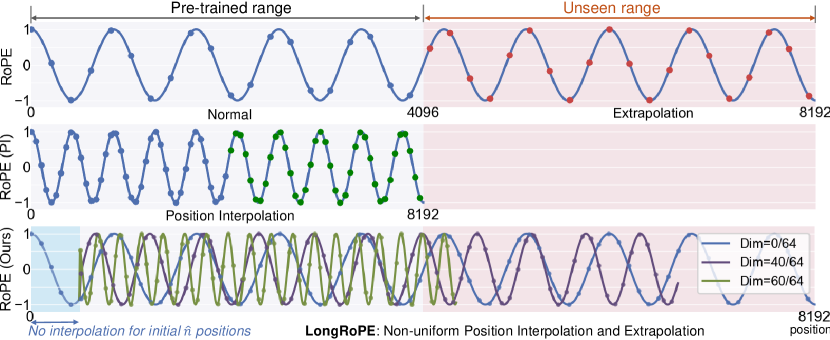
Visual: Uniform vs Non-Uniform Rescaling
Non-Uniform Optimal Rescaling
A key empirical finding from LongRoPE: the optimal \(\lambda_i\) values are highly non-uniform across dimensions. Some dimensions benefit from aggressive rescaling (large \(\lambda_i\)), others benefit from almost none (\(\lambda_i \approx 1\)).
This explains why the three-zone approximation of YaRN works only up to moderate scales, at extreme lengths, the true optimal is complex enough that a three-zone formula is too coarse.
The searched \(\lambda\) vector typically shows:
- Irregular oscillation rather than a clean monotone function of \(i\)
- Some high-frequency dimensions needing no rescaling
- Some mid-frequency dimensions needing more rescaling than YaRN assigns
Why Evolutionary Search Works Here
The evolutionary search for \(\lambda\) is feasible because:
- Objective is cheap to evaluate: given candidate \(\lambda\), compute perplexity on a small set of long documents (no gradient, just a forward pass).
- Problem is low-dimensional: \(\lambda\) has only \(d/2 = 64\) values for a typical head. CMA-ES handles this scale easily.
- Good warm start: initialising from YaRN’s formula gives the search a sensible starting point rather than random noise.
- Model weights stay frozen: the search cannot overfit, it can only find \(\lambda\) values that work well for the existing model.
A single search run (a few thousand forward passes) is far cheaper than thousands of fine-tuning steps.
Results
LongRoPE was evaluated on LLaMA 2-7B extended to various lengths:
| Method | 4k | 8k | 32k | 128k | 256k | 512k |
|---|---|---|---|---|---|---|
| YaRN | ✓ | ✓ | ✓ | ✓ | ✗ | ✗ |
| LongRoPE | ✓ | ✓ | ✓ | ✓ | ✓ | ✓ |
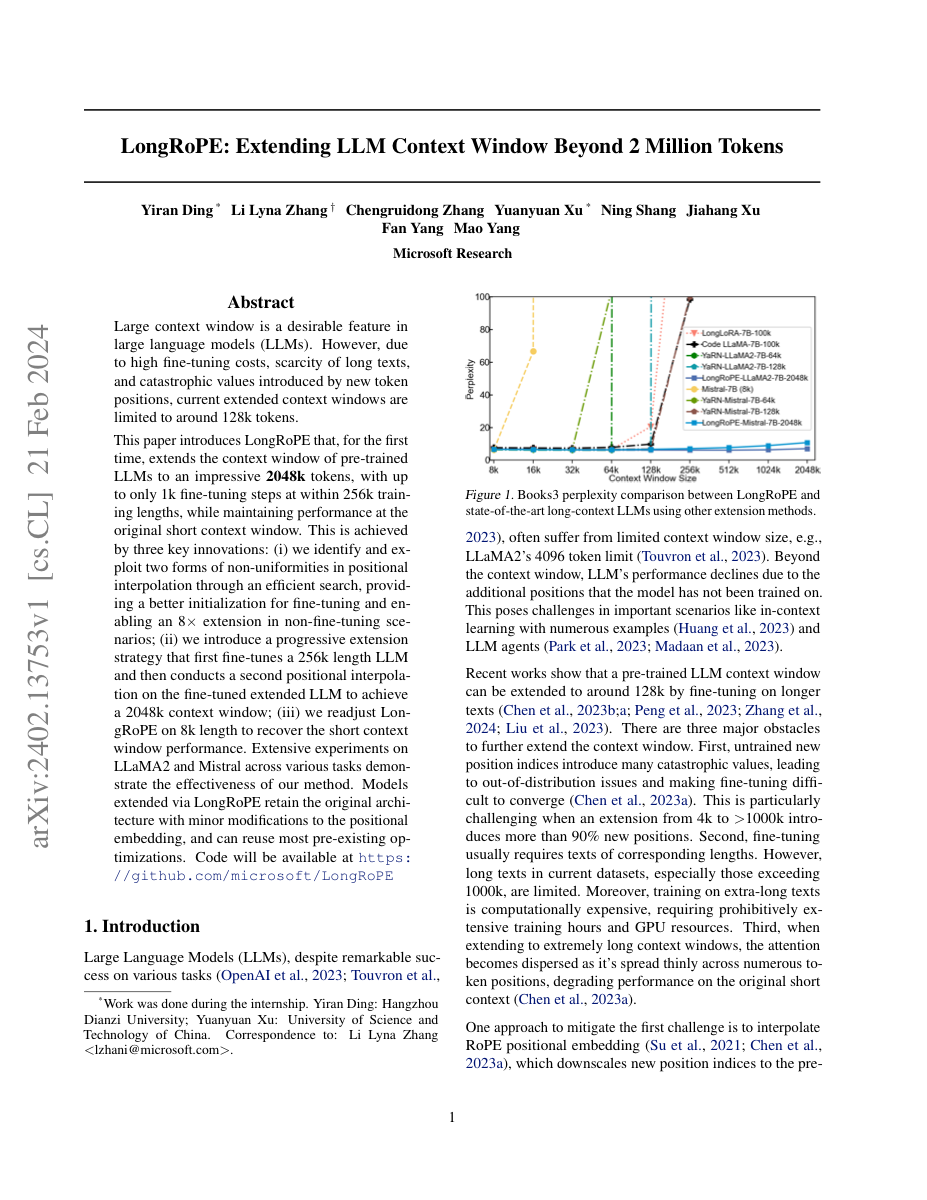
LongRoPE maintains near-original perplexity at 512k tokens. At 2M tokens (the headline result), perplexity increases but the model remains functional for tasks like document retrieval.
Comparison of Context Extension Methods
| Method | Max practical extension | Per-dim tuning | Fine-tuning | Short-context recovery |
|---|---|---|---|---|
| Linear interp | ~8× | No (uniform) | ~1000 steps | Partial |
| NTK scaling | ~4× | No (formula) | Optional | No |
| YaRN | ~32× | Approximate (3 zones) | ~400 steps | No |
| LongRoPE | ~1000× | Yes (searched) | ~600 steps | Yes (Stage 2) |
Where LongRoPE Is Used
- Phi-3 (Microsoft): Phi-3-mini and Phi-3-small use LongRoPE for 128k context
- Phi-3.5-MoE: Also uses LongRoPE
- The technique is increasingly adopted in models targeting very long contexts
Summary
LongRoPE’s key contributions:
- Per-dimension rescaling: each frequency gets its own \(\lambda_i\) instead of a global formula
- Evolutionary search: finds optimal \(\lambda\) without gradient updates, using only perplexity as signal
- Two-stage fine-tuning: Stage 1 for long context, Stage 2 for short-context recovery
- Extreme extension: enables 2M-token context, well beyond what NTK or YaRN can handle
LongRoPE represents the current frontier of positional encoding research, pushing language models toward contexts that can fit entire books, codebases, or hours of transcribed audio.
References
- Ding, Y., Zhang, L. L., Zhang, C., Xu, Y., Shang, N., Xu, J., Yang, F., & Yang, M. (2024). LongRoPE: Extending LLM Context Window Beyond 2 Million Tokens. arXiv 2024 (LongRoPE: non-uniform RoPE rescaling with progressive extension stages, enabling 2M-token context in LLMs).
- Su, J., Lu, Y., Pan, S., Murtadha, A., Wen, B., & Liu, Y. (2021). RoFormer: Enhanced Transformer with Rotary Position Embedding. arXiv 2021 (RoPE: the positional encoding that LongRoPE extends via dimension-specific rescaling factors).
- Peng, B., Quesnelle, J., Fan, H., & Shippole, E. (2023). YaRN: Efficient Context Window Extension of Large Language Models. ICLR 2024 (YaRN: the intermediate approach that LongRoPE builds upon with non-uniform and search-based rescaling).