
VL-JEPA: Predicting Answer Embeddings Before Decoding Words
Published:
Delong Chen, Mustafa Shukor, Théo Moutakanni et al.
Read the paper (PDF)
Several sentences can describe the same event
Intuition first. “A person lifts the cup” and “The cup is picked up” may describe the same visible event. A representation can place those descriptions close together while preserving the distinction from “The cup is put down.” That creates a prediction task whose target is less tied to one particular wording.
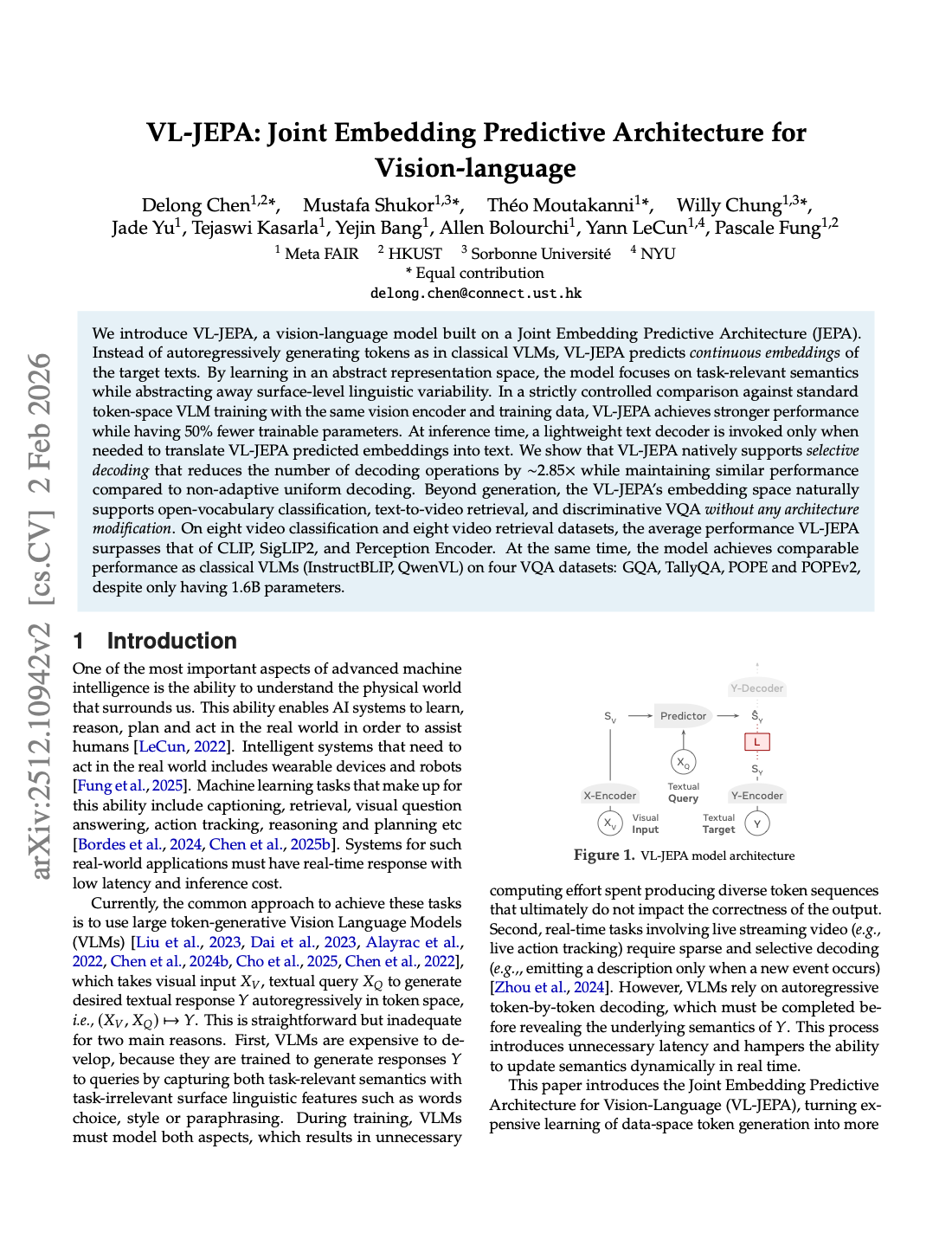
Chen et al. build VL-JEPA with a visual encoder, a query-conditioned predictor, a target text encoder, and a text decoder used when an output sentence is needed. The predictor and target encoder learn jointly with bidirectional InfoNCE. This is a contrastive JEPA variant, so the name does not imply the absence of negative pairs.
Predict a point in text-representation space
Let \(v\) be the visual input, \(q\) the query, and \(y\) its target answer. The prediction path is
For normalised embeddings in a batch of size \(B\), one direction of the contrastive loss is
The reverse direction exchanges predictions and targets. The temperature \(\tau\) controls score scaling. The method section explains why alignment and separation both matter, and distinguishes embedding training from the text-decoding component.
Worked example: a contrastive decision
Suppose the predicted embedding has cosine similarities \(0.8\) and \(0.2\) with the correct answer and one competing answer. With an illustrative temperature \(\tau=0.2\), the scores become 4 and 1. The probability assigned to the correct pair is
Equal similarities would give \(p=0.5\) and loss \(\log 2\approx0.6931\). The loss rewards being closer to the paired answer than to the competitor, rather than simply shrinking both distances.
This also exposes a data issue: a competing caption may actually describe the same event. Batch construction and duplicate or equivalent answers can affect the learning signal. A small loss is not evidence that every “negative” is semantically wrong.
Selective decoding has a useful trade-off
For a video stream, nearby windows may yield similar predicted meanings. VL-JEPA uses that stability to support selective text decoding; its reported efficiency result concerns fewer decoding operations under the paper’s evaluation protocol. It should not be read as a universal end-to-end speedup. Selective decoding experiments.
As an illustrative accounting example, 30 visual updates with 10 decoder calls use one-third as many decodes as decoding every update. The visual encoder and predictor still run, so the overall latency saving depends on how expensive decoding was in the first place.
Evaluate the events skipped between decoded outputs. A small embedding change may conceal a critical transition, such as a hand releasing an object. Decoding less often is useful when the retained updates preserve the distinctions the application needs.
Compare LeJEPA for a distribution-regularised objective, and return to the JEPA overview for the complete reading route.
References
- Chen, D., et al. VL-JEPA: Joint Embedding Predictive Architecture for Vision-language. 2025; revised 2026.