
GCN: Graph Convolutional Networks
Published:
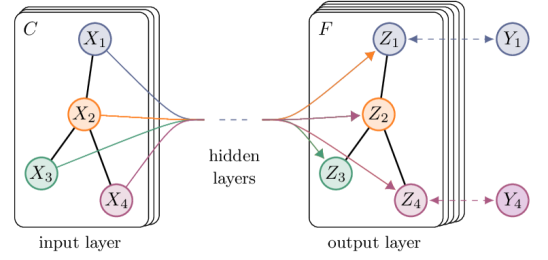
From Spectral Theory to a Practical Layer
As explained in the Graph Laplacian post, spectral graph convolution filters signals using the Laplacian’s eigenvectors. But computing eigenvectors is O(N³), completely infeasible for large graphs.
Kipf & Welling (2016) made two elegant simplifications:
- Localise: approximate the spectral filter as a first-order polynomial in the Laplacian \(L\), only immediate neighbours matter.
- Normalise: use symmetric normalisation to prevent large-degree nodes from dominating.
The result is a layer that can be computed with simple sparse matrix multiplication.
The GCN Formula
Where:
- \(H^{(l)} \in \mathbb{R}^{N \times F_l}\), node features at layer \(l\), one row per node; \(H^{(0)} = X\) is the input feature matrix.
- \(A \in \{0,1\}^{N \times N}\), the plain adjacency matrix of the graph.
- \(\tilde{A} = A + I\), the adjacency with self-loops added.
- \(\tilde{D}\), the diagonal degree matrix of \(\tilde{A}\), i.e. \(\tilde{D}_{ii} = \sum_j \tilde{A}_{ij}\).
- \(\hat{A} = \tilde{D}^{-1/2} \tilde{A} \tilde{D}^{-1/2}\), the symmetrically normalised propagation matrix. This is the object the layer actually multiplies by; \(\tilde{A}\) alone is not normalised.
- \(W^{(l)} \in \mathbb{R}^{F_l \times F_{l+1}}\), the learned weight matrix for layer \(l\).
- \(\sigma\), an elementwise activation function (ReLU).
Throughout this post \(\tilde{A}\) always means \(A + I\) and \(\hat{A}\) always means the normalised propagation matrix, they are two different matrices.
Breaking It Down Step by Step
Let’s trace what happens for a single node \(v\) with neighbours labelled A, B and C (plain labels, not to be confused with the adjacency matrix \(A\)):
Step 1: Add self-loops. \(\tilde{A} = A + I\) ensures \(v\) attends to itself too, not just its neighbours. Without this, a node’s own features would be excluded from the aggregation.
Step 2: Compute normalisation weights. The weight on the edge \(u \to v\) is
This is the symmetric normalisation. It down-weights edges touching high-degree “hub” nodes (which would otherwise dominate).
Step 3: Aggregate. Row \(v\) of \(\hat{A} H^{(l)}\) is a weighted sum of the features of \(v\) and all its neighbours:
Step 4: Transform. Multiply by \(W^{(l)}\): a linear projection to a new feature space.
Step 5: Activate. Apply ReLU (or another non-linearity).
Concrete Numerical Example: One GCN Layer
Consider a 3-node path graph \(1 - 2 - 3\), with node features \(h_1 = [2,0]\), \(h_2 = [0,4]\), \(h_3 = [1,1]\).
Step 1, Add self-loops: \(\tilde{A} = A + I\), so every node gains a self-edge. The degrees of \(\tilde{A}\) are \(\tilde{d}_1 = 2\), \(\tilde{d}_2 = 3\), \(\tilde{d}_3 = 2\).
Step 2, Compute the entries of \(\hat{A} = \tilde{D}^{-1/2}\tilde{A}\tilde{D}^{-1/2}\):
- Edge \((1,2)\): \(1/\sqrt{2 \times 3} \approx 0.408\)
- Edge \((2,3)\): \(1/\sqrt{3 \times 2} \approx 0.408\)
- Self-loop at node 1: \(1/\sqrt{2 \times 2} = 0.5\)
- Self-loop at node 2: \(1/\sqrt{3 \times 3} \approx 0.333\)
- Self-loop at node 3: \(1/\sqrt{2 \times 2} = 0.5\)
Step 3, Aggregate for node 2 (whose closed neighbourhood is \(\{1, 2, 3\}\)):
Step 4, Apply the weight matrix \(W\) and a ReLU:
The weight matrix \(W\) is shared across all nodes and learned by backpropagation.
What GCN Is in MPNN Terms
- MSG: send the neighbour’s features scaled by the normalisation weight, \(\operatorname{MSG}(h_v, h_u) = \hat{A}_{vu} h_u\).
- AGGREGATE: a weighted sum over the closed neighbourhood \(\mathcal{N}(v) \cup \{v\}\), exactly what multiplying by \(\hat{A}\) does.
- UPDATE: apply a single linear layer \(W^{(l)}\) followed by \(\sigma\).
Stacking Layers and the Oversmoothing Problem
With \(k\) GCN layers, each node’s representation captures its \(k\)-hop neighbourhood.
- \(k = 2\): captures 2-hop information (good for most citation/social graph tasks).
- \(k \gg 1\): oversmoothing, repeatedly applying \(\hat{A}\) acts like a random walk that converges towards its stationary distribution, so node representations lose their differences and drift towards a common vector, making nodes indistinguishable.
This is GCN’s main limitation. GAT, GPRGNN, and JK-Nets propose various solutions.
✅ Key Takeaways
- GCN layer: \(H^{(l+1)} = \sigma(\hat{A} H^{(l)} W^{(l)})\), with \(\tilde{A} = A + I\), \(\tilde{D}\) its degree matrix, and \(\hat{A} = \tilde{D}^{-1/2}\tilde{A}\tilde{D}^{-1/2}\) the symmetrically normalised propagation matrix.
- All neighbours contribute with the same fixed weight \(1/\sqrt{\tilde{d}_u \tilde{d}_v}\), no attention, no learned weights on edges.
- Simple and fast: just sparse matrix multiplication + a linear layer.
- Main weakness: oversmoothing with deep stacks; node embeddings lose their differences as layers are added.