
Position Interpolation: Extending RoPE with Minimal Fine-Tuning
Published:
Worked Example: Interpolating from 4k to 16k
Model: LLaMA-2 7B, trained at \(L_{\mathrm{train}} = 4096\), target \(L_{\mathrm{target}} = 16384\) (4× extension).
Without Position Interpolation, naive extrapolation:
- Token at position 5000: RoPE angle for dim \(i=0\) = \(5000 \times \theta_0 = 5000 \times 1.0 =\) 5000 radians
- The model during training never saw an angle beyond 4096 radians for this dimension
- The attention pattern for this token is completely out-of-distribution → garbage output
With Position Interpolation:
- Rescale: \(\mathrm{pos}_{\mathrm{new}} = 5000 \times (4096 / 16384) = 5000 \times 0.25 =\) 1250
- RoPE angle for dim \(i=0\) = \(1250 \times 1.0 =\) 1250 radians
- The model saw angles up to 4096 during training, 1250 is well within this range ✓
- Token at position 16383 maps to: \(16383 \times 0.25 = 4095.75\) ≈ still within training range ✓
The cost: positions that were 1 apart (relative angle \(= \theta\)) now look like they are 0.25 apart (relative angle \(= 0.25 \times \theta\)). The model’s learned sense of “adjacent” vs “nearby” is compressed. A short fine-tuning run (1000 steps) lets it readapt its attention patterns to the new compressed geometry.
Why It Was Such a Big Deal
Once RoPE-based LLMs became standard, the obvious next question was: how do we make them handle longer context without retraining from scratch?
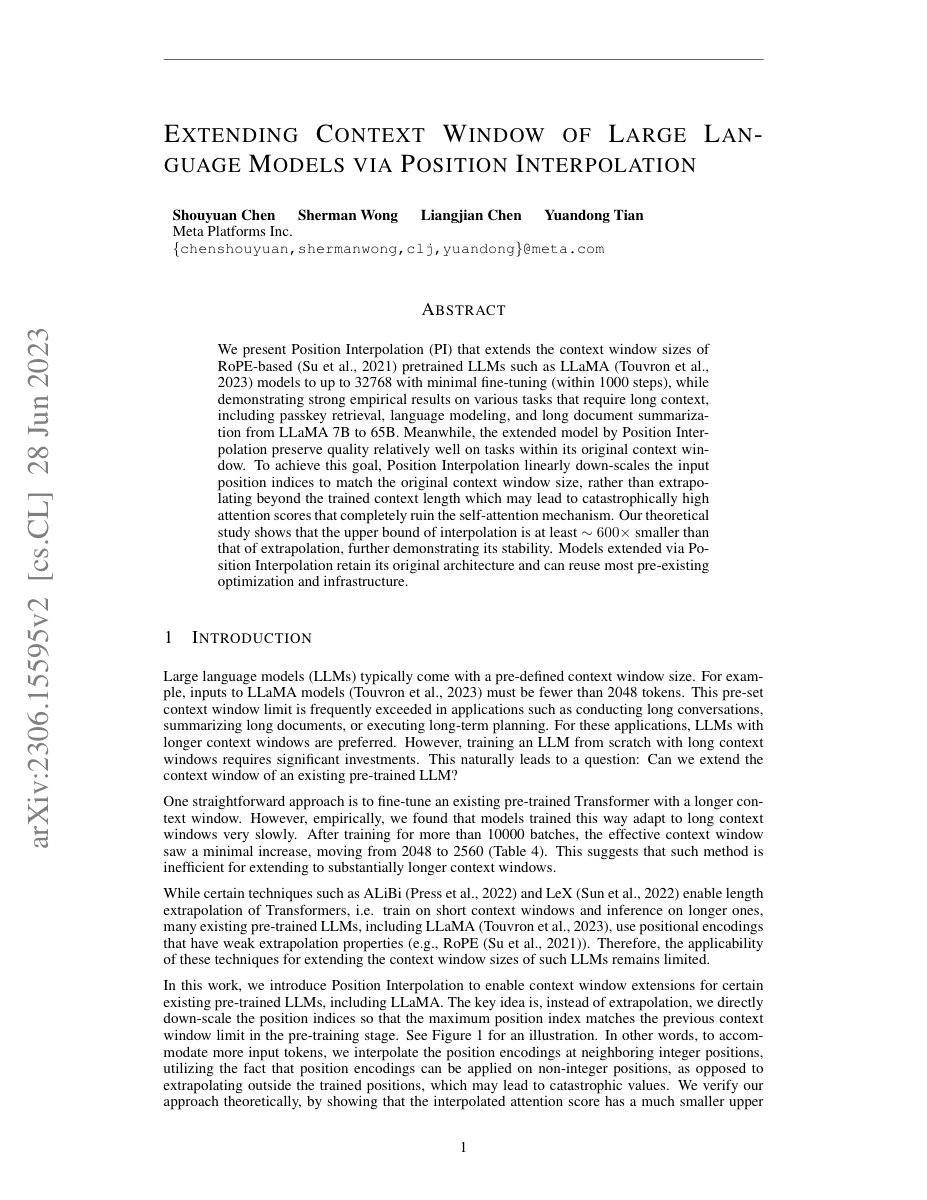
Position Interpolation gave one of the first practical answers. Instead of changing the attention mechanism or inventing a new positional encoding, it simply rescales positions:
If the original model was trained up to (L_{\text{train}}) and you want to run it at (L_{\text{target}}), you compress all coordinates so the rotary angles remain inside a more familiar regime.
What This Changes in Practice
RoPE normally rotates queries and keys by an angle proportional to position. If you double or quadruple context length, those angles can move into regimes the model never learned to interpret.
Position Interpolation avoids that by saying:
the model may read a longer sequence, but the positional coordinates fed to RoPE should move more slowly.
So the token sequence becomes longer, but the positional trajectory through rotary space becomes denser and less extreme.
Why Fine-Tuning Still Matters
PI is much better than naive extrapolation, but it is not magic. Compressing positions changes the geometry of how nearby and far-away tokens are separated. The model usually benefits from a short adaptation phase so it can relearn how to use that modified geometry.
That is why Position Interpolation is often described as:
- simple
- effective
- cheap to adapt
but not fully “free” in the way NTK-aware scaling tries to be.
How It Fits in the RoPE Family
Position Interpolation is the baseline long-context RoPE extension recipe. Later methods can be read as refinements:
- NTK-aware scaling changes frequencies instead of compressing positions directly
- YaRN mixes interpolation and extrapolation across frequency bands
- LongRoPE searches for dimension-wise rescaling schedules
So PI is worth knowing because it is the conceptual bridge between plain RoPE and the more advanced long-context methods.
When to Use It
PI makes sense when:
- you already have a trained RoPE model
- you want a longer context quickly
- you can afford a short fine-tuning run
It is especially useful as a baseline, because if a fancier method does not clearly beat PI, that method probably is not worth the complexity.
✅ Key Takeaways
- Position Interpolation extends RoPE by compressing positions before applying rotary embeddings.
- It preserves the architecture and keeps the change local to the positional mechanism.
- It usually works well with light fine-tuning, making it a practical context-extension baseline.
- Conceptually, it sits right before NTK scaling, YaRN, and LongRoPE in the long-context RoPE story.
References
- [1] Chen, S., Wong, S., Chen, L., Tian, Y. (2023). Extending Context Window of Large Language Models via Positional Interpolation. arXiv 2023.
- [2] Su, J., Lu, Y., Pan, S., Murtadha, A., Wen, B., Liu, Y. (2021). RoFormer: Enhanced Transformer with Rotary Position Embedding. arXiv 2021.