
NTK-Aware Scaling: Extending Context Without Fine-Tuning
Published:
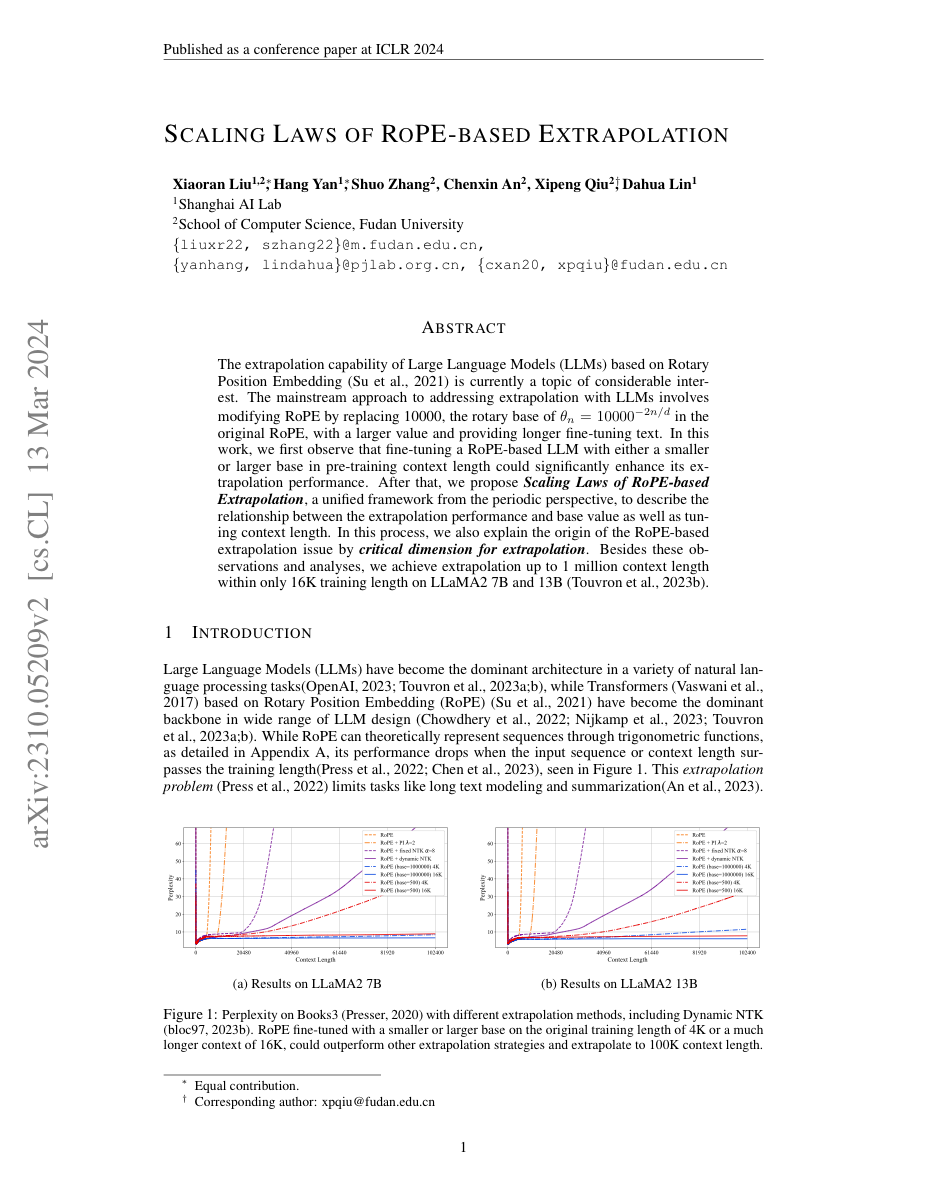
The Context Extension Problem
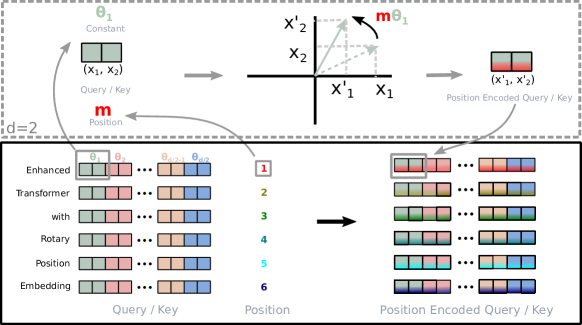
RoPE (Rotary Position Embedding) encodes the position of each token by rotating query and key vectors at dimension-specific frequencies. A model trained with RoPE on sequences up to length \(L\) learns to use those frequencies, but when you try to run it on sequences longer than \(L\), the model sees rotation angles it has never encountered.
Naïve position interpolation (scaling positions linearly: \(\mathrm{pos} \to \mathrm{pos} \times L/L'\)) works but degrades high-frequency dimensions catastrophically, they change too fast across the rescaled positions, destroying local structure.
RoPE Frequencies: A Quick Recap
In RoPE, dimension pair \(i\) of a \(d_k\)-dimensional key or query is rotated by:
With \(\mathrm{base} = 10000\) (the original RoPE default), frequencies range from \(1\) (low-frequency, long-range position signal) to \(1/10000^{d/d} \approx 0.0001\) (high-frequency, fine-grained local signal).
High-frequency dimensions complete many rotation cycles within a short context window. Low-frequency dimensions rotate slowly across the full context.
Visual Intuition: Frequency Saturation
What Breaks at Long Context
When context length exceeds training length, two problems arise:
High-frequency dimensions have seen all their cycles, they wrap around and lose uniqueness. Two distant positions may map to nearly the same rotation angle.
Attention patterns based on relative angles degrade, the model’s learned sense of “close” vs “far” tokens breaks down.
The NTK-Aware Scaling Insight
Proposed independently by /u/bloc97 on Reddit (2023) and connected to Neural Tangent Kernel theory, NTK-Aware Scaling replaces the base \(\theta\) with a larger value:
Where:
- \(L\) = original training context length
- \(L'\) = desired new context length
- \(d\) = head dimension
For example, extending LLaMA (trained at \(L = 2048\)) to \(L' = 8192\):
This larger base stretches all frequencies proportionally. High-frequency dimensions that previously completed a full cycle within \(L\) tokens now complete their cycle within \(L'\) tokens, no dimension becomes “saturated” at the new length.
NTK vs Linear Interpolation
| Method | High-freq dims | Low-freq dims | Fine-tuning needed |
|---|---|---|---|
| Linear interpolation | Severely degraded | Good | Often needed |
| NTK scaling | Preserved | Good | Usually not needed |
Linear interpolation scales positions but keeps frequencies fixed, the high-frequency dimensions see too many cycles per unit position. NTK scaling changes the frequencies to match the new scale.
Worked Example: Computing the NTK Base
Model: LLaMA-2 7B, trained at \(L = 4096\), head dimension \(d = 128\), original \(\mathrm{base} = 10{,}000\).
Target: extend to \(L' = 32{,}768\) (8× extension)
The new base of ~83,600 means every RoPE frequency \(\theta_i = 1/\mathrm{base}^{2i/d}\) is reduced by a factor of ~8×, spreading cycles proportionally over 8× more tokens.
For dimension \(i = 0\) (lowest frequency):
- Original: \(\theta_0 = 1/10{,}000^{0} = 1.0\) (full rotation per token, highest freq)
- After NTK: \(\theta_0 = 1/83{,}600^{0} = 1.0\) (unchanged, already handles short range fine)
For dimension \(i = 63\) (highest frequency of the pair, near \(d/2\)):
- Original: \(\theta_{63} = 1/10{,}000^{126/128} \approx 1/7{,}244 \approx 0.000138\)
- After NTK: \(\theta_{63} = 1/83{,}600^{126/128} \approx 1/60{,}600 \approx 0.0000165\)
The highest-frequency dimension now completes its cycle every ~60,600 tokens instead of ~7,244, scaled with the 8× target extension.
Dynamic NTK Scaling
A practical variant applies NTK scaling dynamically at inference time, adjusting the base only for sequences that exceed the training length:
def get_ntk_base(seq_len, training_len=2048, base=10000, dim=128):
    if seq_len <= training_len:
        return base
    scale = seq_len / training_len
    return base * (scale ** (dim / (dim - 2)))
This is zero-cost for short sequences and automatically extends context for long ones. LLaMA.cpp and many inference engines implement this by default.
Limitations
- NTK scaling degrades gradually as \(L'/L\) increases. At 8× extension (e.g., 2k → 16k), quality noticeably drops without at least a small amount of fine-tuning.
- It is a post-hoc fix, not a principled training strategy. For best long-context performance, fine-tuning with the new scale (or using YaRN) is recommended.
- It does not address the attention sink problem, very long sequences still have attention pattern degradation.
Summary
| Property | Value |
|---|---|
| Core idea | Rescale RoPE base to stretch frequencies to longer contexts |
| Fine-tuning | Not required for moderate extension (2-4×) |
| Quality at 8× | Degrades; short fine-tune recommended |
| Implementation | Single hyperparameter change (new base value) |
| Relation to linear interpolation | Complementary, fixes what interpolation breaks |
NTK-Aware Scaling is the simplest way to extend the context of an existing RoPE model. For more sophisticated extension, see YaRN.
References
- Su, J., Lu, Y., Pan, S., Murtadha, A., Wen, B., & Liu, Y. (2021). RoFormer: Enhanced Transformer with Rotary Position Embedding. arXiv 2021 (RoPE: rotary position embeddings that encode relative positions; the basis for NTK-Aware Scaling).
- Bloc97 (2023). NTK-Aware Scaled RoPE allows LLaMA models to have extended (8k+) context size without any fine-tuning and minimal perplexity degradation. Reddit r/LocalLLaMA 2023 (original NTK-Aware Scaling proposal: rescales RoPE base to preserve high-frequency information during context extension).
- Chen, S., Wong, S., Luo, L., & Tian, Y. (2023). Extending Context Window of Large Language Models via Positional Interpolation. arXiv 2023 (Position Interpolation: the alternative to NTK scaling that linearly rescales positions, requires fine-tuning but more stable).