
Why Geometry Matters in Graph Neural Networks
Published:
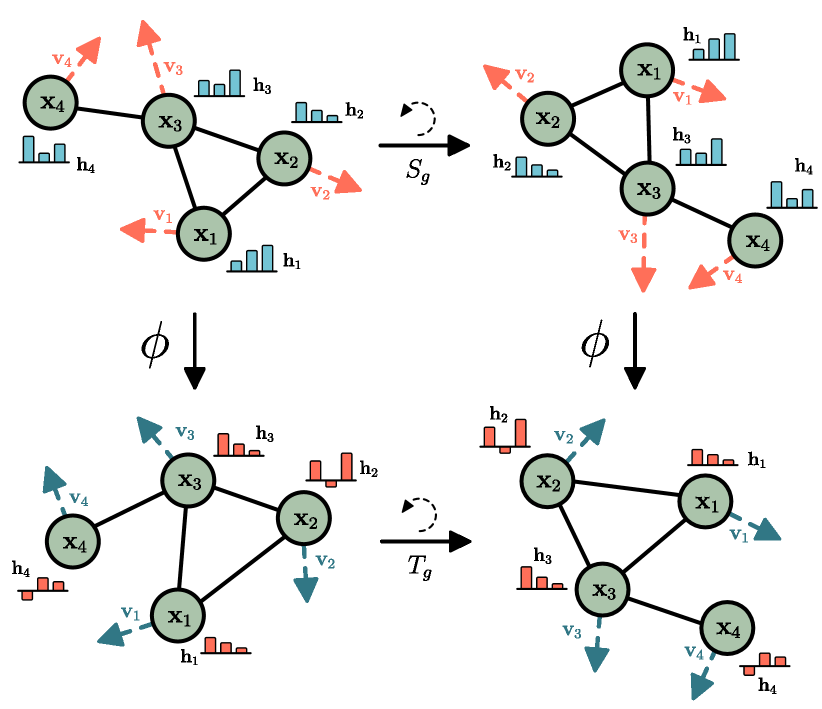
The Geometric Setting
Intuition First: Imagine you have a molecular model kit. You can describe the connectivity, carbon bonded to two oxygens, without saying how those bonds are arranged in 3D space. But a flat (180°) CO₂ and a bent (120°) arrangement have wildly different properties. Standard GNNs only read the assembly instructions; geometric GNNs also read the 3D blueprint.
Consider a molecule modelled as a graph \(G = (V, E, H, X)\):
- \(V\): atoms (nodes), \(E\): bonds (edges), \(H = \{h_v\}\): atomic features (atom type, charge)
- \(X = \{x_v\}\) with \(x_v \in \mathbb{R}^3\): the 3D coordinate of each atom
Standard GNNs use only \((V, E, H)\) and ignore \(X\). This loses crucial information:
Stereoisomers: molecules with the same atoms and bonds but different 3D arrangement. L-alanine and D-alanine are mirror images, identical connectivity, different biological activity. A GNN without 3D coordinates assigns them the same embedding; so, as it happens, does any model built purely from interatomic distances, since distances survive reflection unchanged.
Conformation: proteins fold into specific 3D shapes that determine their function. Two proteins with the same sequence but different folds (conformers) have different biological roles, invisible to connectivity-only GNNs.
Distances and angles: in chemistry, reaction rates depend on bond angles and dihedral angles, geometric properties that cannot be inferred from connectivity alone.
The Symmetry Problem
3D coordinates are not unique to a molecule. Writing \(g\) for a symmetry transformation acting on coordinates as \(x_v \mapsto Q x_v + t\):
- Translation (\(t\)): moving the molecule in space leaves chemistry unchanged
- Rotation (\(Q\) with \(\det Q = +1\)): rotating the molecule leaves chemistry unchanged
- Reflection (\(Q\) with \(\det Q = -1\)): mirroring leaves most scalar properties unchanged, but swaps enantiomers, and those can differ biologically
Rotations plus translations form \(\mathrm{SE}(3)\); adding reflections gives \(\mathrm{E}(3)\). Which one you want is a modelling decision, not a detail: an \(\mathrm{E}(3)\)-invariant model is by construction unable to tell L-alanine from D-alanine, because it assigns mirror images the same output. If chirality matters for your target, you want \(\mathrm{SE}(3)\) and features that change sign under reflection.
Failure mode: naive addition of coordinates to node features gives the model different inputs for the same molecule in different orientations. The model must learn the symmetry from data, requiring training examples covering all orientations, and even then only approximately.
Invariance vs Equivariance
Let \(\Phi\) be the network, \(g\) a group element, and \(\rho(g)\) the representation of \(g\), the concrete matrix by which \(g\) acts on a given space.
Invariant: the output does not move at all when the input is transformed.
For graph-level scalar properties (energy, solubility): the property is invariant. Rotating the molecule doesn’t change its energy.
Equivariant: the output transforms too, under the group’s action on the output space, which need not be the same as its action on the input space.
For node-level vector properties (forces, velocities): the property is equivariant with \(\rho_{\text{out}}(g) = Q\). Rotate the molecule and the forces rotate with it.
Invariance is the special case \(\rho_{\text{out}}(g) = I\) for every \(g\), the trivial representation. Writing both with \(\rho_{\text{in}}\) and \(\rho_{\text{out}}\) made explicit is worth the extra symbols, because “\(\Phi(g x) = g \Phi(x)\)” hides the fact that the two \(g\)’s act on different spaces and are generally different matrices.
What Standard GNNs Cannot Do
| Task | Requires | Standard GNN |
|---|---|---|
| Distinguish stereoisomers | Reflection-sensitive 3D features | Cannot |
| Predict 3D forces | Equivariant vectors (\(\rho_{\text{out}}(g) = Q\)) | Cannot |
| Learn protein structure | 3D coordinates + symmetry | Cannot |
| Model crystal symmetry | Space group symmetry | Cannot |
| Point cloud processing | 3D position | Cannot |
What Geometric GNNs Add
Three levels of geometric sophistication:
Level 1: Distance-based (invariant) Add interatomic distances \(\lVert x_u - x_v \rVert\) as edge features. Distances are unchanged by translation, rotation and reflection, so such a model is \(\mathrm{E}(3)\)-invariant. Two consequences: it cannot predict vector quantities at all, and it cannot distinguish enantiomers.
Level 2: Angle-based (richer invariant) Add angles between bond triplets \((u, v, w)\) and dihedral angles \((u, v, w, z)\). DimeNet and SphereNet operate at this level. Bond angles are still reflection-invariant; it is the signed dihedral angle that flips sign under reflection, which is why torsions, not angles, are what buy you chirality sensitivity.
Level 3: Equivariant (full 3D) Process 3D vectors as vectors, not just their magnitudes. EGNN, SE(3)-Transformers, NequIP, MACE operate at this level.
Real Applications
Drug discovery: predict binding affinity, toxicity, ADMET properties from 3D molecular structure.
Protein structure prediction: model protein folding and protein-protein interaction geometry.
Materials science: predict crystal properties (band gap, stability) from atomic positions in unit cell.
Robotics: process point cloud sensor data while maintaining rotational equivariance.
Particle physics: predict particle interaction properties with detector geometry.
Summary
Adding geometry to GNNs is not optional for applications where 3D structure matters. The challenge is doing so while respecting the symmetries of 3D space, translation, rotation, and (depending on the target) reflection. State which group you actually want: \(\mathrm{E}(3)\) invariance is the right default for energies, but it forecloses chirality by construction. The subsequent posts in this section cover the architectures (EGNN, SE(3)-Transformers, TFN) that build these constraints in systematically.
References
- Bronstein, M. M., Bruna, J., Cohen, T., & Veličković, P. (2021). Geometric Deep Learning: Grids, Groups, Graphs, Geodesics, and Gauges. arXiv 2021 (the unifying geometric deep learning blueprint: symmetry groups, equivariance, and the 5G framework).
- Schütt, K. T., Kindermans, P.-J., Sauceda Felix, H. E., Chmiela, S., Tkatchenko, A., & Müller, K.-R. (2017). SchNet: A Continuous-Filter Convolutional Neural Network for Modeling Quantum Interactions. NeurIPS 2017 (SchNet: distance-based interaction filters for molecular property prediction).
- Klicpera, J., Groß, J., & Günnemann, S. (2020). Directional Message Passing for Molecular Graphs. ICLR 2020 (DimeNet: directional message passing over bond angles, recovering angular information that a cutoff-graph distance model cannot, though bond angles alone remain reflection-invariant).