
Diagonal, Orthogonal, and General Sheaf Maps
Published:
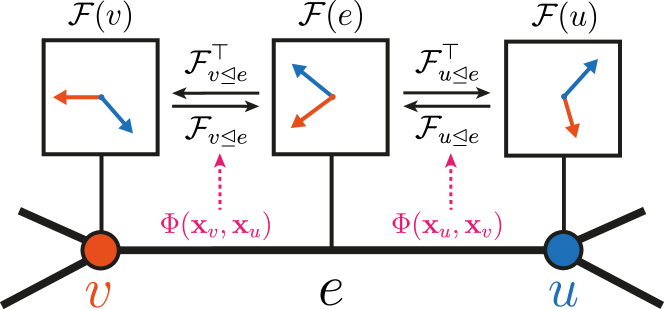
The Design Space of Restriction Maps
Intuition First: Think of the four map types as four ways to describe the relationship between two people’s views of the same object. A scalar map says “person B sees things three times more intensely than person A, and possibly with the opposite sign.” A diagonal map says “person B weights each channel differently.” An orthogonal map says “person B is looking from a rotated angle, same information, different frame.” A general map says “person B’s perception is an arbitrary linear combination of person A’s.” The richer the class, the more relationships the sheaf can represent, and the more numbers the predictor must output per edge.
In Neural Sheaf Diffusion the predictor \(\Phi\) outputs a restriction map \(\mathcal{F}_{v \trianglelefteq e}\) for each incidence (node, incident edge), so two maps per undirected edge. The counts below are the degrees of freedom of the matrix \(\Phi\) must produce, which fixes its output width; they are not free parameters stored per edge.
Scalar Maps (\(d = 1\))
Degrees of freedom per incidence: 1. All stalks are \(\mathbb{R}\), so the sheaf Laplacian is \(n \times n\).
What it represents: a signed edge weight. The off-diagonal block reduces to
so the transport along the edge is \(\mathcal{F}_{v \trianglelefteq e}\mathcal{F}_{u \trianglelefteq e}\), positive for “these should agree”, negative for “these should be opposite”.
Connection to existing models: if the two endpoint maps are forced to be equal, the resulting operators are exactly the positively-weighted graph Laplacians, the family GCN and ChebNet already use. Allowing them to differ in sign is what buys anything new, and it recovers signed-attention models such as FAGCN rather than GAT (whose softmax weights cannot be negative).
Limitation: the harmonic space of a \(d = 1\) sheaf is at most one-dimensional, so no scalar sheaf can linearly separate three or more classes in the diffusion limit, no matter how the signs are chosen. That is the argument for widening the stalks.
Diagonal Maps
What it represents: per-coordinate scaling and sign flipping, a set of \(d\) independent scalar sheaves stacked into one.
Sheaf Laplacian block: \((L_{\mathcal{F}})_{vu} = -\operatorname{diag}(f^v_1 f^u_1, \dots, f^v_d f^u_d)\), itself diagonal. The Laplacian therefore decouples across the \(d\) stalk coordinates: they interact only through the left multiplication by \(W_1\) in the NSD layer.
Advantage: \(O(d)\) outputs per incidence instead of \(O(d^2)\), diagonal blocks, and cheaper sparse products.
Separation capacity: since a diagonal sheaf is \(d\) independent scalar sheaves, a one-vs-all construction shows that \(d \ge C\) suffices to linearly separate \(C\) classes, expressive, but only by spending stalk width.
Limitation: no coupling between stalk coordinates inside the operator. What node \(u\) means by coordinate 1 is what node \(v\) means by coordinate 1; only magnitudes and signs differ, not directions.
Orthogonal Maps
Degrees of freedom per incidence: \(d(d-1)/2\), the dimension of the Lie group \(O(d)\). In NSD these are realised as a composition of Householder reflections.
What it represents: rotations and reflections, a rigid change of frame.
Key property: \(\mathcal{F}_{v \trianglelefteq e}^{\top}\mathcal{F}_{v \trianglelefteq e} = I_d\), so the diagonal blocks collapse:
This makes the normalisation \(D^{-1/2}\) trivial, \(D\) is just the degrees, whereas for general maps it requires the inverse square root of a genuine positive semi-definite block matrix.
Separation capacity: orthogonal maps use the available stalk space more efficiently than diagonal ones. Bodnar et al. show that \(C \le 2d\) classes can be separated with \(O(d)\)-bundles (proved for \(d \in \{2, 4\}\)), against \(d \ge C\) for diagonal maps.
Connection geometry: a sheaf with orthogonal restriction maps is a discrete \(O(d)\)-bundle, a discrete analogue of a vector bundle with orthogonal structure group, where the maps play the role of parallel transport. It is flat only when the holonomy around every cycle is the identity; that is a property a given sheaf may or may not have, not part of the definition. This is what gives orthogonal sheaf GNNs a foothold in differential geometry, and it is developed further in the post on equivariant sheaf GNNs.
General Linear Maps
Degrees of freedom per incidence: \(d^2\) for square \(d \times d\) maps.
What it represents: arbitrary linear transformations, mixing, scaling, rotating, and projecting features. Any linear relationship between the two endpoint stalks is representable.
Costs: \(O(d^2)\) outputs per incidence, dense blocks, \(O(\lvert E \rvert d^2)\) storage for the Laplacian, and, more awkwardly, the normalisation requires computing \(D^{-1/2}\) for a positive semi-definite block matrix rather than reading off degrees. Maximal flexibility also brings the highest risk of overfitting, which is why the most general class is not automatically the best-performing one.
Summary Comparison
| Map type | DoF per incidence | Stalk-coordinate coupling | Geometric meaning | Classes separable |
|---|---|---|---|---|
| Scalar (\(d=1\)) | 1 | n/a | Signed edge weight | \(\le 2\) |
| Diagonal | \(d\) | None (only via \(W_1\)) | Per-coordinate scaling and sign | \(C \le d\) |
| Orthogonal | \(d(d-1)/2\) | Full | Frame rotation / reflection | \(C \le 2d\) |
| General | \(d^2\) | Full | Arbitrary linear | , |
Practical Recommendations
Use diagonal maps when: the graph is large, the Laplacian must be cheap to build and multiply, and per-coordinate scaling with sign flips is enough. In practice this class is surprisingly competitive.
Use orthogonal maps when: the geometry of the feature space matters, numerical stability of the normalisation matters, or the connection-Laplacian interpretation is useful. In the NSD experiments the \(O(d)\)-bundle model was the strongest overall.
Use general maps when: you have reason to believe the task needs feature mixing that a rigid frame change cannot express, and you have enough data to avoid overfitting.
Impact on Sheaf Laplacian Sparsity
For every map type the sheaf Laplacian has the same block sparsity pattern as the graph Laplacian: an \((nd) \times (nd)\) matrix with at most \(2\lvert E \rvert\) off-diagonal blocks plus \(n\) diagonal blocks. What changes is the density inside each block.
- Diagonal maps: each block is diagonal, so the whole operator is sparse even in the expanded \(nd\) indexing.
- Orthogonal maps: off-diagonal blocks are dense, but the diagonal blocks are \(\deg(v) I_d\) and cost nothing to store.
- General maps: every block is dense, giving \(O(\lvert E \rvert d^2)\) storage.
References
- Bodnar, C., Di Giovanni, F., Chamberlain, B. P., Liò, P., & Bronstein, M. M. (2022). Neural Sheaf Diffusion: A Topological Perspective on Heterophily and Oversmoothing in GNNs. NeurIPS 2022 (defines the hierarchy of symmetric, diagonal, orthogonal, and general restriction maps, with the separation results and the empirical comparison quoted above).
- Hansen, J., & Ghrist, R. (2019). Toward a Spectral Theory of Cellular Sheaves. Journal of Applied and Computational Topology (spectral properties of sheaf Laplacians that the map classes inherit).
- Barbero, F., Bodnar, C., Sáez de Ocáriz Borde, H., Bronstein, M., Veličković, P., & Liò, P. (2022). Sheaf Neural Networks with Connection Laplacians. ICML 2022 Workshop on Topology, Algebra, and Geometry in Machine Learning (computes orthogonal restriction maps geometrically instead of learning them end-to-end, cutting the cost and the overfitting risk of fully learned maps).
- Barbero, F., Bodnar, C., Sáez de Ocáriz Borde, H., & Liò, P. (2022). Sheaf Attention Networks. NeurIPS 2022 Workshop on Symmetry and Geometry in Neural Representations (combines restriction maps with attention, trading some of the cost of dense maps for a sparser, attention-weighted operator).